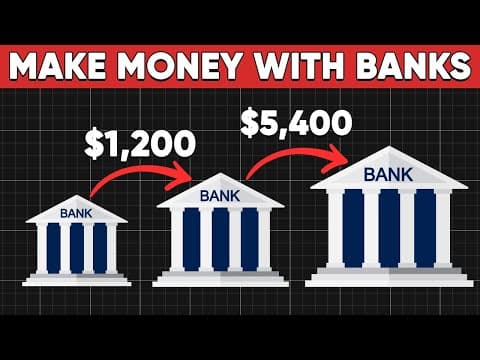
This article explores five critical insights about the banking system that reveal how money is created, who controls it, and how banks operate, emphasizing the importance of understanding these concepts to make informed financial decisions.
Andrew Jackson once stated, "If the people only understood the rank injustice of our money and banking system, there would be a revolution by morning." This sentiment rings true even today, as the banking system continues to favor the wealthy, often at the expense of the average person. Many individuals lack a fundamental understanding of how money is created and how the Federal Reserve operates, leading to a system where only a small minority benefits. In this article, we will uncover five crucial truths about money that banks would rather keep hidden.
One of the most intriguing aspects of our financial system is that money is essentially debt. People spend their lives working hard, building businesses, and striving to earn more money, yet few understand the origins of money itself. Most assume that the government is responsible for printing money, but in reality, the government borrows money just like individuals do, often accumulating far more debt than one can imagine.
When the government needs funds for infrastructure projects like schools and hospitals, it borrows from the Federal Reserve, which creates money out of thin air using ink and paper. This money enters the economy when the government spends it, and it eventually makes its way into banks. However, this is just a small fraction of how money is created. Approximately 95% of money exists as digital entries in bank computers.
When you deposit money in a bank, the institution does not simply store it; instead, it lends out a significant portion of it at higher interest rates. Banks are permitted to lend out 90% of your deposit while keeping only 10% on hand for withdrawals. This practice allows banks to create more money through a process known as fractional reserve banking. For instance, if you deposit $100, the bank can lend out $90 while still showing that your $100 is available for withdrawal. This cycle continues, multiplying the initial deposit into a much larger sum.
The most perplexing aspect of this system is that the money created as loans must be repaid with interest, meaning that more money is owed than exists in the system. This creates a perpetual cycle of debt that can never truly be resolved.
To understand the Federal Reserve's role, we must look back at its inception. The United States faced significant financial turmoil in the 19th century, lacking a central bank to manage crises. The panic of 1907 highlighted this need when a series of bank failures led to a stock market crash. In response, wealthy bankers, led by J.P. Morgan, intervened to restore confidence in the banking system.
Recognizing the necessity of a central bank, a group of influential bankers and politicians convened at Jekyll Island in Georgia to draft a plan. In 1913, the Federal Reserve was established, comprising 12 regional banks. These banks are owned by the commercial banks in their respective regions, meaning that the Federal Reserve is essentially controlled by the banking industry itself. This structure raises questions about the fairness and transparency of the system, as major banks wield significant influence over the very institution that regulates the money supply.
Many people mistakenly believe that banks are there to help them achieve financial freedom. However, banks are profit-driven corporations focused on maximizing returns for their shareholders. Their primary goal is not to provide the best financial advice but to sell products and services that benefit the bank.
When a bank representative offers you a financial product, remember that they have undergone training to persuade you to purchase it. It is crucial to think critically and compare options across different banks rather than blindly accepting their recommendations. Your financial well-being should be your priority, not the bank's profits.
Traditionally, banks were designed to take deposits from those with excess funds and lend them to those in need. However, the modern financial landscape has shifted. Individuals living paycheck to paycheck are often seen as less valuable to banks, as they generate minimal profit. In contrast, wealthy clients receive preferential treatment, including lower interest rates and better loan terms.
This disparity is evident in mortgage rates, where ultra-wealthy individuals often secure much lower rates than the average consumer. Banks are incentivized to attract and retain wealthy clients, leading to a system that disproportionately benefits the rich.
Many individuals express frustration over low interest rates offered by banks, which often fail to keep pace with inflation. Historically, lending money and earning interest was a lucrative business, but that is no longer the case. Today, money lacks intrinsic value, and banks should be viewed as institutions for managing funds rather than investment vehicles.
If you wish to keep your money in a bank, consider investing in bank stocks instead. For example, Goldman Sachs offers a dividend rate that exceeds typical fixed deposit rates, allowing you to benefit from both dividends and potential stock appreciation while becoming a part-owner of the bank.
In conclusion, understanding the intricacies of the banking system is essential for making informed financial decisions. By recognizing the truths about money, the Federal Reserve, and the motivations of banks, individuals can better navigate their financial futures and invest wisely in real assets.
If you found this information enlightening, consider exploring more resources on personal finance and investment strategies to empower your financial journey.