
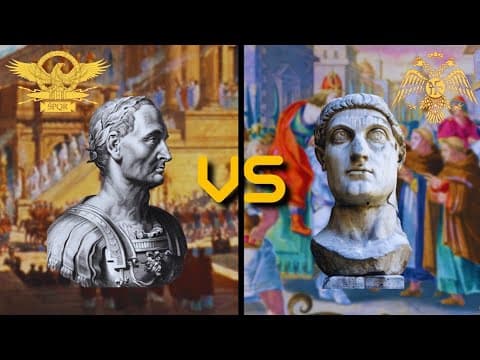
This blog post explores the similarities and differences between the Roman Empire and the Byzantine Empire, focusing on their military strategies, cultural identities, economic structures, legal systems, and contributions to Christianity, highlighting how these two empires shaped the course of history.
In the annals of history, two mighty empires stand out: the ancient Roman Empire and its counterpart in the East, the Byzantine Empire. This post delves into the characteristics, legacies, and influences of both empires, examining their military strategies, cultural identities, economic structures, legal systems, and contributions to Christianity.
The Roman Empire's influence stretched across centuries, dominating vast territories and leaving an unforgettable mark on the world. Renowned for its unmatched military strength, Rome's armies conquered lands from Britannia in the north to North Africa and the Levant in the south. However, Rome was not just about conquest; it was also a cultural hub. Its cities were bustling with activity, featuring grand buildings like temples and amphitheaters. Rome was a center of learning and creativity, producing philosophers, poets, and thinkers whose works continue to inspire us today.
Rome's military prowess was complemented by innovative strategies and impressive engineering feats that supported its expansion. The disciplined legions developed sophisticated formations and techniques, such as the testudo or tortoise formation, which provided protection against projectiles. The extensive network of roads allowed for rapid troop movements and efficient supply lines, enabling Rome to maintain control over its vast territories.
The Byzantine Empire emerged from the eastern half of the Roman Empire after its split, continuing many of Rome's traditions while developing its unique culture and identity. Known for its art, architecture, and trade, the Byzantine Empire flourished in its capital, Constantinople. The interactions between these two empires profoundly shaped history, influencing politics, culture, and religion across the Mediterranean and beyond.
Byzantium was a synthesis of Roman heritage, Greek influence, and Christian faith. Its legal system, administrative structure, and language reflected its Roman roots, while Greek culture permeated its society. Christianity, adopted as the state religion, played a central role in shaping Byzantine identity and ideology. Art and architecture flourished, with lavish mosaics adorning churches and palaces, and the Hagia Sophia standing as a crowning achievement of Byzantine architecture.
The economic structure of the Roman Empire was primarily agrarian, with agriculture as the backbone of the economy. Vast estates known as latifundia dominated the rural landscape, often worked by slaves or tenant farmers. The surplus agricultural output sustained urban populations and served as a vital source of revenue for the state through taxation and trade. Major cities like Rome, Alexandria, and Carthage emerged as bustling commercial centers.
In contrast, the Byzantine Empire exhibited a more diversified and dynamic economy. While agriculture remained important, the economy also relied heavily on trade, manufacturing, and taxation. Constantinople served as a thriving economic hub, strategically located along key trade routes, including the Silk Road and the Mediterranean Sea. The imperial government actively regulated markets and enforced commercial laws, creating a cosmopolitan atmosphere that reflected the empire's multicultural character.
The legal system of the Roman Empire was instrumental in shaping legal principles that endure today. The Twelve Tables represented a landmark development, providing a written code of laws that governed various aspects of society, addressing property rights, inheritance, and criminal offenses.
Building upon Roman law, the Byzantine Empire refined its legal system to reflect its multicultural and religiously diverse society. Legal scholars like Tribonian compiled and codified Roman law, resulting in the Corpus Juris Civilis, which preserved and systematized legal principles. The emergence of canon law, governing the affairs of the Eastern Orthodox Church, integrated religious and secular legal traditions, contributing to the distinctiveness of Byzantine legal culture.
The military strategies of the Roman Empire were integral to its survival and expansion. The disciplined legions utilized sophisticated formations and techniques, allowing them to achieve military supremacy. The extensive road network facilitated rapid troop movements, maintaining control over vast territories.
The Byzantine Empire inherited and adapted Roman military traditions to confront unique challenges. Faced with threats from external enemies, Byzantine commanders devised innovative defensive strategies. One notable weapon was Greek Fire, a highly flammable substance used to defend against naval attacks. The Byzantine military maintained a professional standing army, including the Varangian Guard, which played a crucial role in defending the capital and maintaining internal stability.
In summary, while the Roman and Byzantine Empires shared certain characteristics and legacies, including their contributions to Christianity, they exhibited distinct administrative structures, diplomatic strategies, and cultural identities. The Roman Empire's centralized authority and formidable military contrasted with the Byzantine Empire's intricate bureaucracy and adept diplomacy. Together, these empires shaped the course of history, leaving enduring legacies that continue to influence our understanding of the past and our cultural heritage.



















