
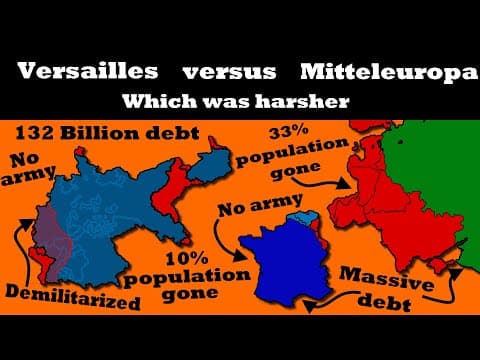
This article examines the fairness of the Treaty of Versailles by comparing it to treaties imposed by Germany and its allies on defeated nations during World War I and earlier conflicts. It explores territorial losses, ethnic considerations, and strategic interests, providing context on German perspectives and the actual implementation of Versailles' terms, ultimately questioning whether Versailles was harsher or more lenient than German plans would have been.
The Treaty of Versailles, signed in 1919, is often criticized for its harshness towards Germany following World War I. This article seeks to answer a focused question: How harsh was the Treaty of Versailles compared to other treaties of the time, particularly those imposed by the German Empire or its allies on defeated nations?
While many debates surround Versailles—especially its role in leading to World War II—this analysis concentrates solely on the fairness of the treaty itself. To do so, it compares Versailles to German-imposed treaties and plans, providing insight into German views on just victory and whether Germany would have been more lenient had the roles been reversed.
One of the most significant aspects of Versailles was the territorial concessions demanded from Germany. These included:
Loss of Colonial Empire: Germany lost all its overseas colonies to the Entente powers. Although symbolically damaging to German prestige, these colonies were not economically vital by this time.
Eastern European Territories: Germany had made substantial gains in Eastern Europe during the war, which had to be relinquished. The Polish majority region of Posen rose up to break away from Germany. To ensure Poland's economic viability, a corridor to the sea was created, known as the Polish Corridor. This corridor included mostly Polish populations, except for the port city of Danzig, which was predominantly German.
The Free City of Danzig: To resolve British objections to Poland gaining Danzig directly, the city was made a Free City with autonomy but was required to guarantee Polish port access.
Memel Region: This Lithuanian-majority area was initially placed under international rule but was later taken by Lithuania after an uprising.
Plebiscites: Several regions were subjected to plebiscites to decide whether they would join Poland or Germany. Ultimately, Germany retained most of these areas, losing only minor parts of Silesia to Poland and Czechia.
Western Borders: Belgium acquired Eupen-Malmedy, a small German-populated region, while France re-annexed Alsace-Lorraine, a territory with a mixed German and French population but a German-speaking majority.
Saarland: France desired the coal-rich Saarland for strategic reasons, but Britain and America opposed outright annexation. Instead, it became a League of Nations mandate with a future referendum planned.
The territorial losses accounted for approximately 10% of Germany's population and 13% of its territory. While these were serious losses, many of the territories lost had majority populations ethnically aligned with the nations they joined. For example, most eastern territories were majority Polish or Lithuanian, and many decisions were made through plebiscites rather than unilateral Entente imposition.
To understand the fairness of Versailles, it is essential to consider German plans had they won the war. The German foreign office had drafted treaties and territorial arrangements that were often harsher or more expansive than those imposed on Germany. However, it is important to note that Germany had little intention of fully implementing these plans.
The German approach to victory included significant territorial expansion and control over neighboring states, often disregarding ethnic compositions and local self-determination. This contrasts with the Entente's approach, which, despite its flaws, incorporated plebiscites and international oversight in some cases.
When comparing Versailles to treaties Germany imposed or planned, several points emerge:
Ethnic Considerations: Versailles generally respected ethnic majorities in territorial adjustments, whereas German plans often prioritized strategic interests over ethnic realities.
Strategic Interests: Both sides sought to secure strategic advantages. France's desire for Alsace-Lorraine and Saarland was driven by defense and resource needs, while Germany aimed for broader control in Eastern Europe.
Implementation: Versailles' terms were enforced with international oversight, including mandates and plebiscites, whereas German-imposed treaties often lacked such mechanisms.
Severity: While Versailles imposed significant penalties on Germany, the German plans for defeated nations were often more severe in terms of territorial loss and political control.
The Treaty of Versailles, while punitive, was not uniquely harsh when placed in the context of contemporary treaties and German plans. Many territorial losses reflected ethnic realities and strategic compromises rather than arbitrary punishment. Germany's own plans for victory suggest that had the roles been reversed, Germany might have imposed even harsher terms.
Thus, the fairness of Versailles can be better understood by comparing it to the standards and expectations of the time, including German perspectives on just victory. This comparative approach reveals that Versailles was a complex treaty balancing retribution, justice, and geopolitical realities rather than an excessively harsh or unjust settlement.
This analysis does not seek to justify or glorify any political party or individual but aims to provide a nuanced understanding of the Treaty of Versailles in historical context. By examining both the treaty's contents and German attitudes, we gain a clearer picture of the post-World War I landscape and the challenges of peace-making in a fractured Europe.
Your thoughts and reflections on this topic are welcome as we continue to explore the intricate history of international treaties and their lasting impacts.



















