
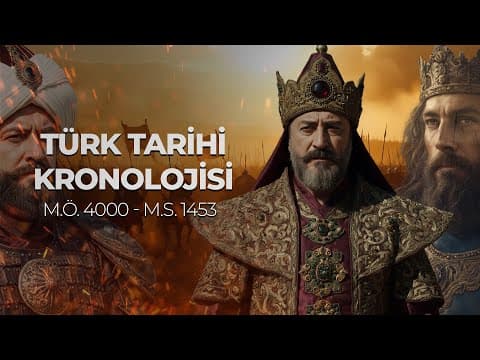
This blog post provides a detailed chronological overview of Turkish history from the Anav culture around 4000 BC to the fall of Constantinople in 1453 AD, highlighting key cultures, migrations, and significant events that shaped the Turkish identity and statehood.
This post aims to provide a detailed chronological overview of Turkish history, tracing the development of Turkish culture and statehood from the Anav culture around 4000 BC to the fall of Constantinople in 1453 AD. It highlights key cultures, migrations, and significant events that shaped the Turkish identity.
The Anav culture, believed to be one of the earliest Turkish cultures, emerged around 4000 BC near Ashgabat in present-day Turkmenistan. Archaeological findings suggest that the inhabitants of this culture were likely the ancestors of the Turks. Evidence of settled life, including stone houses and agricultural tools, indicates their adaptation to a sedentary lifestyle. Additionally, the domestication of sheep and cattle was practiced.
From 3000 BC, the Kelteminar culture around the Aral Sea is considered to be associated with the ancestors of the Turks. The first documentary records of the Huns date back to 2255 BC, marking a significant point in Turkish history.
The Afanasyevo culture, which existed between 2500 and 1700 BC, is recognized as the oldest culture in the Turkish homeland. It originated in the Abakan steppes and expanded from the Altai Mountains to the Volga River. Artifacts from this culture include bone needles, flint arrowheads, copper knives, and simple pottery.
Following the Afanasyevo culture, the Andronovo culture emerged between 1700 and 1200 BC, spanning the steppes between the Altai and Tian Shan mountains. This culture left traces across various regions, including Siberia, and is considered a continuation of the Afanasyevo culture.
The Karasuk culture, which followed the Andronovo culture, was located around Lake Baikal. This culture is notable for its iron mining and processing, and it featured four-wheeled carts, felt tents, and woolen clothing.
From the 8th century BC, the Scythians emerged on the historical stage, migrating from Central Asia towards the northern Black Sea. They established a significant tribal union and advanced into Anatolia, influenced by the movements of neighboring tribes.
By the 4th century BC, the Huns began to migrate westward, leading to significant interactions with other cultures and tribes. The construction of the Great Wall of China began in 308 BC to protect against Hun invasions.
Mete Khan, the founder of the Great Hun Empire, ascended to power in 209 BC after defeating his father, Tan. This marked the beginning of a powerful empire that would dominate the region for centuries.
By 54 BC, the Huns split into two factions, leading to internal conflicts and a decline in their power. The division was exacerbated by external pressures from the Chinese and other neighboring states.
The first Turkish state, the Göktürk Khaganate, was established in 552 AD by Bumin Khan. This marked a significant turning point in Turkish history, as the Göktürks unified various tribes and expanded their territory.
The Seljuks emerged as a powerful force in the 11th century, establishing a vast empire that included parts of Persia and the Middle East. Their victory at the Battle of Manzikert in 1071 was crucial in securing Turkish dominance in Anatolia.
The Crusades marked a significant period of conflict between Christian and Muslim forces, with the Seljuks defending their territories against invading Crusaders. The battles during this time were pivotal in shaping the political landscape of the region.
The Ottoman Empire was founded in 1299 by Osman Gazi, marking the beginning of a new era in Turkish history. The Ottomans would go on to become one of the most powerful empires in history, expanding their influence across Europe, Asia, and Africa.
The history of the Turkish people is rich and complex, marked by the rise and fall of various cultures and empires. From the early Anav culture to the establishment of the Ottoman Empire, each period contributed to the development of a unique Turkish identity that continues to influence the region today. Understanding this history is essential for appreciating the cultural and historical significance of the Turkish people in the world.



















