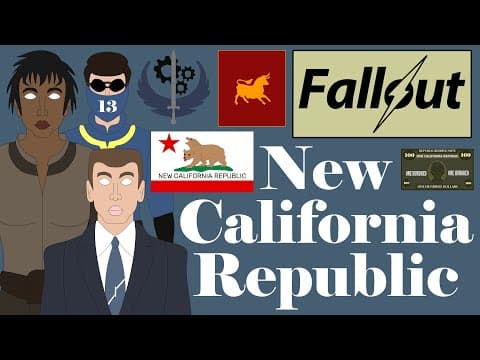
This article explores the detailed history of the New California Republic (NCR) in the Fallout universe, from its origins in Vault 15 and Shady Sands to its political structure, cultural evolution, conflicts with factions like the Brotherhood of Steel and Caesar's Legion, and eventual decline under militaristic leadership. It highlights key events, leaders, and societal changes shaping the NCR's rise and challenges.
"War, war never changes." This iconic phrase sets the tone for the post-apocalyptic world of Fallout, where decades of competition for dwindling resources culminated in a nuclear catastrophe. The United States government, anticipating nuclear war, commissioned Vault-Tec to build 122 vaults across the nation. These vaults were ostensibly designed to shelter segments of the population. However, in collaboration with the Enclave—a secretive deep state conspiracy—only 17 vaults functioned as intended. The remaining 105 vaults conducted social, physical, and psychological experiments to test human endurance and obedience, aiming to gather data to rebuild civilization either by conquering the wasteland or colonizing another world.
On October 23, 2077, the Great War began and ended within hours as nations launched nuclear weapons, destroying human civilization and killing billions. The President of the United States secured his life by retreating to a Poseidon Company oil rig off the California coast, prepared by the Enclave to survive the apocalypse.
In the years following, many vault residents endured various experiments. Vault 15 in California, for example, housed people of diverse cultures and ideologies, which led to the formation of competing factions. By 2097, these factions were on the brink of violent conflict. To avoid self-destruction, Vault 15 opened its doors. Those who left formed raider gangs such as the Vipers, Khans, and Jackals, while those seeking peace used the vault's Garden of Eden Creation Kit (GECK) to establish the settlement of Shady Sands.
Between 2161 and 2163, the fate of Shady Sands changed dramatically when the legendary Vault Dweller left Vault 13 to find a replacement water chip for their purification system. During his journey, he earned the trust of Aradesh and his daughter Tandi, prominent citizens of Shady Sands.
The Vault Dweller later rescued Tandi from the Khan raiders, killing the gang and becoming a hero. However, Darion, son of the Khan leader Garl Death Hand, survived and founded the New Khans to seek vengeance.
The Vault Dweller also destroyed the Unity Army of super mutants and their leader, the Master. Upon returning, the Vault Dweller was denied reentry to Vault 13 and subsequently founded the Village of Arroyo.
With the largest raider threat eliminated, Shady Sands prospered under Aradesh and Tandi, expanding trade routes and fostering cultural exchanges. They proposed unification and the formation of a nation-state, which gained rapid support.
The NCR aligned with the Followers of the Apocalypse, a peaceful faction dedicated to knowledge and healing, which opened a university. They also established friendly relations with the Brotherhood of Steel, a militaristic faction focused on preserving old-world technology. Although the Brotherhood did not formally join the NCR, the government named a state after their founder, Roger Maxson, and hosted one of their outposts in Shady Sands.
Founded primarily by Aradesh and Tandi, the NCR reflected prewar democratic values:
The NCR banned slavery (except prison labor), open carry of firearms within city limits (allowing concealed carry), public drunkenness, drug use, gambling, and prostitution within city limits.
Immigration laws allowed settlers to apply for citizenship after training and tax agreement. Territories could apply for annexation.
The government had three branches:
Aradesh served as President until his death in 2196, succeeded by his daughter Tandi, regarded as the best NCR leader. She won every reelection and remained in power for life.
Under Tandi:
After Tandi's death, leaders Joanna Tibbett, Wendell Peterson, and Aaron Kimball oversaw the NCR's decline:
Resource depletion made scavenging less profitable, forcing many to work for large companies. Many citizens believed the NCR was no longer a land of opportunity, prompting migration eastward.
The NCR grew to 700,000 people and clashed with factions:
NCR attacked the Brotherhood's Mojave branch, eliminating over half their forces, forcing retreat to Hidden Valley.
Brotherhood raids destroyed gold reserves backing NCR dollars, forcing a switch to fiat currency. Distrust led many to revert to bottle caps as currency.
In 2253, 38 NCR citizens were massacred by Mojave Raiders. President Tibbit was removed and replaced by Wendell Peterson, who sent battalions to pacify the Mojave by 2270 under General Aaron Kimball, the "Hero of the Mojave."
In 2271, the Mojave Desert Rangers unified with NCR Rangers to protect Nevada from Caesar's Legion, a brutal Roman-style slaver army expanding westward.
Kimball's poor leadership led to predictions of famine by 2291 unless food production increased.
Robert House, a wealthy genius surviving via life support and supercomputer connection, feared NCR expansion into New Vegas. He allied with local factions to defend independence.
The Treaty of New Vegas granted Hoover Dam and McCarran Airport to the NCR in exchange for 5% of dam energy and New Vegas's continued independence.
Caesar's Legion attacked but was lured into a trap in Boulder City, resulting in a decisive NCR victory.
Kimball's popularity declined due to the prolonged Mojave campaign, resource depletion, and high casualties.
The New California Republic rose from the ashes of nuclear war, embodying democratic ideals and striving for peace and prosperity. However, internal corruption, militarism, and external conflicts challenged its stability. The NCR's history is a complex tale of hope, leadership, conflict, and decline in the harsh wasteland of Fallout's universe.
This comprehensive history provides insight into the political, social, and military evolution of the NCR, highlighting its significance in the Fallout series and its reflection of post-apocalyptic societal challenges.