
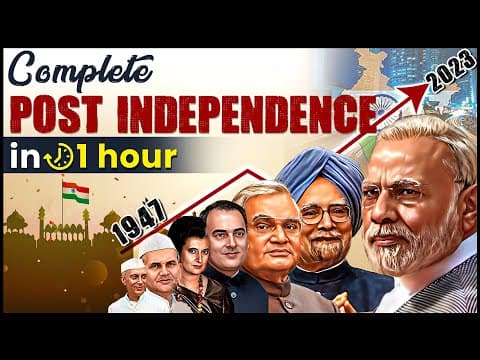
This blog post provides a detailed exploration of India's post-independence history, highlighting key milestones, challenges, and achievements from 1947 to the present, including the partition, integration of princely states, economic reforms, and significant political events.
India gained independence on August 15, 1947, marking the end of British colonial rule. However, this event was not the conclusion of India's historical journey but rather the beginning of a new era filled with challenges and opportunities. The post-independence history of India is rich and complex, often overlooked in the UPSC syllabus, making it essential for aspirants to understand its nuances. This blog post aims to provide a comprehensive overview of India's post-independence history, focusing on significant milestones, challenges faced, and achievements made over the years.
The partition of India and Pakistan on August 14, 1947, was a monumental event that came at a great cost. It resulted in the displacement of approximately 14.5 million people and led to communal riots that claimed the lives of an estimated 200,000 to 2 million individuals. The boundary commission, led by Sir Cyril Radcliffe, hastily drew borders with limited resources and knowledge, leading to significant chaos and violence. The partition not only divided territories but also created deep-seated communal tensions that continue to affect India today.
Upon gaining independence, India faced several immediate challenges:
Integration of Princely States: Approximately 500 princely states existed, each with its own ruler. The integration of these states into the Indian Union was a significant challenge. Sardar Vallabhbhai Patel played a crucial role in persuading many rulers to join India through diplomatic means and negotiations.
Communal Violence: The partition led to widespread communal violence, particularly in Punjab and Bengal, where millions were displaced and many lost their lives. The government had to manage refugee camps and restore order amidst the chaos.
Political Stability: Establishing a stable political system was crucial. The Indian Constitution was adopted on January 26, 1950, laying the foundation for a democratic framework.
Post-independence, India focused on economic development through various reforms:
In recent years, India has witnessed significant political and economic changes:
The post-independence history of India is a testament to the resilience and determination of its people. From the challenges of partition and integration to the strides made in economic development and political stability, India has come a long way. Understanding this journey is crucial for appreciating the complexities of contemporary India and its position in the global arena.



















