
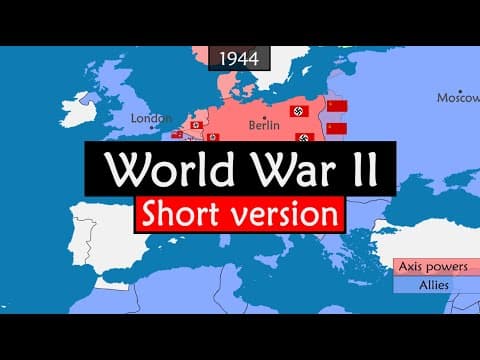
World War II was a global conflict involving millions, triggered by the aftermath of World War I, economic turmoil, and the rise of totalitarian regimes. Key events include the rise of Nazi Germany, the Axis Powers' formation, significant battles, and the eventual Allied victory, leading to a reshaped world order and the emergence of the US and USSR as superpowers.
World War II stands as the largest armed conflict that humanity has ever known, involving tens of millions of fighters across the globe. This blog post retraces the main events of this deadly war, exploring its origins, key battles, and the aftermath that reshaped the world.
The seeds of World War II were sown in the aftermath of World War I. Germany and its allies faced defeat and were held solely responsible for the war. Heavy sanctions were imposed, leading to the dismantling of the Austro-Hungarian and Ottoman empires. Germany was burdened with what many considered an unreasonable debt, losing colonies and territories, including the recreation of Poland. These sanctions were perceived as humiliating by the German populace, contributing to a weakened economy.
The German economy suffered from hyperinflation, with national mints attempting to address the crisis by printing excessive banknotes. Between 1914 and November 1923, the value of the German mark plummeted by 1,000 billion. Although radical measures were taken to stabilize the economy, the Wall Street crash of 1929 triggered the worst economic crisis of the 20th century, severely impacting Germany and leading to skyrocketing unemployment.
In this climate of despair, nationalism surged, culminating in the rise of the Nazi Party led by Adolf Hitler in 1933. Despite the strict conditions imposed after World War I, the new totalitarian regime restored military service and pursued an aggressive foreign policy aimed at uniting all German-speaking peoples.
Italy, despite its victory in World War I, felt cheated by the territorial gains and was ruled by the fascist party of Benito Mussolini since 1922. Italy began a colonial policy, seizing Ethiopia and preparing to invade Albania. Meanwhile, Japan pursued its expansionist agenda, taking advantage of the civil war in China to invade new territories and committing atrocities against civilian populations.
In Spain, a civil war erupted, pitting the Republican government, supported by the USSR and International Brigades, against the nationalist camp led by Francisco Franco, aided by Italy and Germany. This conflict allowed both Germany and Italy to test their military capabilities.
Germany's territorial ambitions escalated as it annexed Austria and invaded Czechoslovakia. Following the occupation of parts of Lithuania, Germany signed a non-aggression pact with the USSR, which included plans to divide Europe. The invasion of Poland in September 1939 prompted the United Kingdom and France to declare war, marking the official beginning of World War II.
Germany employed a new military strategy known as Blitzkrieg, characterized by rapid, high-intensity attacks. This strategy led to swift victories in Denmark, Norway, Luxembourg, the Netherlands, and Belgium, culminating in the fall of France and the signing of an armistice.
Germany, Italy, and Japan formed the Axis Powers, while all British dominions and colonies, except Ireland, entered the war. In Africa, fighting erupted between Italian colonies and Allied forces. Despite extensive bombing campaigns, Germany failed to conquer Britain, prompting Hitler to shift his focus towards the USSR.
On June 22, 1941, Axis forces launched a massive invasion of the USSR, marking one of the largest military operations in history. German troops advanced rapidly, laying siege to Leningrad and reaching the gates of Moscow, where they faced a brutal winter. Meanwhile, the SS perpetrated mass killings of Slavic and Jewish populations.
Japan's expansion led to tensions with the United States, culminating in a surprise attack on Pearl Harbor on December 7, 1941. This attack prompted the US to enter the war on the side of the Allies, initially focusing on the Pacific front while providing support to the USSR.
Japan's military campaign in Asia was marked by horrific atrocities, including forced labor camps and sexual slavery. In Europe, the Nazis established concentration and extermination camps, targeting Jews, resistance fighters, and various marginalized groups.
Fearing an Allied invasion, Hitler constructed the Atlantic Wall along the coast of Europe. However, the Allies launched operations in North Africa and Sicily, leading to the Italian armistice and the rapid advance of Soviet forces in the East.
On June 6, 1944, the Allies landed in Normandy, leading to the liberation of Paris and a series of victories across Europe. As the war drew to a close, the Allies announced the formation of the United Nations, aimed at maintaining peace and security.
On April 30, 1945, Adolf Hitler committed suicide in his bunker as Soviet forces closed in. Germany surrendered eight days later, marking a significant turning point in the war.
The United States and USSR joined forces to defeat Japan, with the Soviets invading Manchuria and the US dropping atomic bombs on Hiroshima and Nagasaki. Japan surrendered on August 15, 1945, officially ending World War II.
The human toll of World War II was staggering, with at least 60 million dead, predominantly civilians. Many cities lay in ruins, and millions of German prisoners faced harsh conditions. The war resulted in the division of Germany and Austria among the victors, leaving Europe and the USSR exhausted.
In the aftermath, the United States and USSR emerged as the dominant global superpowers. Despite the establishment of the United Nations, tensions between the two nations would lead to indirect confrontations around the world, setting the stage for the Cold War.



















