
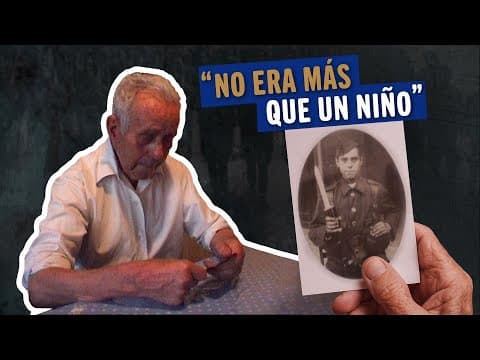
This blog post recounts the poignant testimony of Francisco Rivera, a soldier in the Spanish Civil War, detailing his experiences from enlistment to the war's aftermath, including battles, injuries, and the moral complexities of wartime actions.
In this blog post, we delve into the significant testimony of Francisco Rivera, a veteran of the Spanish Civil War, as recounted in a recording from 2009. Francisco, born on October 4, 1917, in Ferramulín, a small village in Galicia, shares his experiences from the war that lasted from 1936 to 1939. His story provides a personal glimpse into the life of a soldier during one of Spain's most tumultuous periods.
Francisco grew up in a rural environment, working in the fields like many of his neighbors. He was drafted into the army in 1937, a year earlier than expected, as the war escalated. He recalls the day he was called to serve, stating, "You have to show up in Lugo on the 27th of July." After a brief period of training in Ferrol, he was assigned to the Asturias front as part of the 4th Battalion of the Infantry Regiment Zamora, nº 29.
Upon arriving at the Asturias front, Francisco quickly learned that the fighting had ceased, but the war was far from over. He was part of the 5th Navarre Brigade, which included various infantry units. Francisco vividly remembers the equipment he was issued, including a Mauser rifle, hand grenades, and a gas mask. He describes the conditions at the front, particularly during the battle of Teruel, where he witnessed the devastation firsthand: "It was no longer Teruel, it was a dump."
In December 1937, Francisco participated in the battle of Teruel, which saw heavy fighting as the Republican army attempted to hold the city. He describes the chaos and destruction, noting that the area was heavily fortified by the enemy, making any advance perilous. The German aviation played a significant role in the conflict, contributing to the destruction of the landscape.
As the war progressed, Francisco was involved in the Republican army's last major offensive at the Ebro River in July 1938. During this time, he was wounded for the first time while on duty at the Segre River. He recounts the moment he was hit by shrapnel and the subsequent chaos at the command post, where many soldiers were either dead or wounded.
After recovering in a hospital in Pamplona, Francisco returned to the front, only to be wounded again shortly after. This time, he was treated in an improvised hospital in Vitoria, where he witnessed the Francoist army's complete takeover of Catalonia.
As the war drew to a close in February 1939, Francisco found himself in Toledo, where he faced one of his most traumatic experiences. After the war officially ended, he was involved in the execution of prisoners, a task that weighed heavily on him. He describes the moral conflict of being ordered to execute individuals who may not have been guilty of any crime.
Despite the war's end, Francisco remained in the army for two additional years, witnessing further historical events, including the great fire of Santander in 1941. It wasn't until April 15, 1941, that he was finally discharged and returned home.
When asked about his experiences and what he took away from the war, Francisco humorously remarked, "Lice. Many lice." His testimony serves as a poignant reminder of the personal toll of war and the lasting impact it has on those who serve.
Francisco Rivera passed away in November 2013 at the age of 96, leaving behind a legacy of memories from a generation that endured the horrors of the Spanish Civil War. His story is a vital part of history, providing insight into the complexities of war and the human experience within it. Through his testimony, we gain a deeper understanding of the sacrifices made and the indelible marks left on the lives of those who lived through such turbulent times.



















