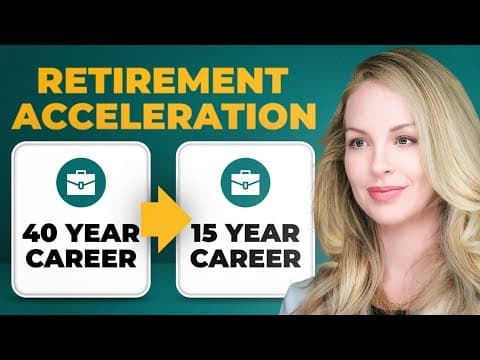
Discover effective strategies to compress your retirement timeline from decades to just 15-20 years. Learn about aggressive saving, investment acceleration, and multiple income streams to achieve financial independence faster than traditional methods suggest.
In today's fast-paced world, the traditional retirement timeline of 40 years is becoming increasingly outdated. Many individuals are seeking ways to retire much earlier, and with the right strategies, it is entirely possible to compress this timeline to just 15 to 20 years. In this blog post, we will explore various acceleration strategies that can help you achieve early retirement legally and effectively.
Traditional retirement plans are often based on the assumption of a 40-year career, where individuals save a small percentage of their income over time, typically relying on employer pensions. However, with the decline of traditional pensions, individuals now have the opportunity to adopt more aggressive wealth-building strategies that were not available to previous generations.
The conventional advice of saving 10 to 15% of one’s income and aiming for retirement in one’s 60s may work for many, but it unnecessarily extends the timeline for those who are motivated to retire early. Higher savings rates, strategic income increases, and smart tax optimization can significantly shorten the working years required to achieve financial independence.
Participating in your company's employer plan can provide significant advantages. For instance, taking advantage of employer matches is essentially free money. Additionally, employee stock purchase plans allow employees to buy company stock at a discount, creating immediate value and potential for wealth accumulation.
Health Savings Accounts (HSAs) are another powerful tool, offering triple tax exemptions that can save money on healthcare costs now and in the future.
The phrase "invest early and often" holds profound significance. Starting to invest early, even with small amounts, allows your money to grow over time, benefiting from the power of compounding. For example, if Susan invests $500 a month from age 20 to 30, she could accumulate nearly a million dollars by age 65, while Mark, who starts later and invests more, ends up with less despite contributing significantly more.
While not essential, eliminating debt can significantly accelerate your path to retirement. Paying off high-interest debts frees up cash flow that can be redirected toward investments. For instance, Sarah, who eliminated her monthly debt payments, was able to redirect that money into her retirement accounts, potentially adding over $200,000 to her portfolio by age 60.
Creating multiple income streams is one of the most effective ways to accelerate retirement. For example, Jason, a software engineer, supplements his income through consulting and rental properties, allowing him to invest significantly more than his salary alone would permit. This diversification not only increases his financial capacity but also provides tax advantages and reduces reliance on a single income source.
Expense optimization is crucial in the journey to early retirement. By maintaining a modest lifestyle and funneling excess income into investments rather than lifestyle upgrades, individuals can effectively buy years of freedom. This strategic decision-making helps balance living well now and in retirement.
The traditional notion that one must work for decades to afford retirement is no longer a rule but rather an option. By implementing these acceleration strategies, you can compress your retirement timeline into 15 to 20 years or less. Whether it’s maximizing employer benefits, investing early, eliminating debt, or developing multiple income streams, each strategy plays a vital role in achieving financial independence faster than conventional methods suggest.
If you are interested in specific guidance on how to implement these strategies in your own life, consider watching training videos or seeking advice from financial professionals. The journey to early retirement is not just about age; it’s about strategy and making informed financial decisions that align with your goals.