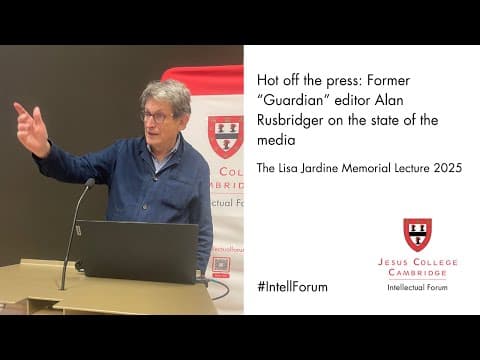
In a lecture honoring Lisa Jardine, Alan Rusbridger reflects on the current state of journalism, emphasizing the importance of factual reporting amidst a landscape of misinformation and declining trust in media. He draws parallels between historical events and today's challenges, advocating for a return to the core principles of journalism and the need for media literacy.
In a recent lecture at Jesus College, Alan Rusbridger, former editor of The Guardian, delivered a compelling tribute to the late Lisa Jardine while addressing the pressing issues facing journalism today. The event, part of the Lisa Jardine Memorial Lecture series, highlighted Jardine's pioneering contributions to academia and media, setting the stage for Rusbridger's insights into the current media landscape.
Sita Reain, the Master of Jesus College, opened the event by reflecting on Jardine's remarkable career. Elected as the first female fellow at Jesus College in 1976, Jardine was a prolific scholar whose work spanned English literature, cultural history, and the history of science. Her influence extended beyond academia into policymaking, where she served on various councils and authorities, including the Royal Society and the Human Fertilization and Embryology Authority.
Rusbridger, who began his journalism career at the Cambridge Evening News, shared personal anecdotes about Jardine, emphasizing her role as a fearless advocate for truth and justice. He noted that her commitment to factual reporting was a guiding principle in his own career.
Rusbridger's lecture focused on the craft of journalism, which he believes is increasingly under threat in today's media environment. He began by referencing the Peterloo Massacre of 1819, a pivotal moment in British history that underscored the importance of accurate reporting. John Edward Taylor, a businessman and reporter, documented the events, ensuring that the truth was recorded despite attempts by authorities to distort the narrative. This historical example served as a foundation for Rusbridger's argument about the necessity of journalism in holding power accountable.
Rusbridger emphasized the mantra "comment is free, but facts are sacred," originally articulated by the Manchester Guardian's founder. He lamented the current state of journalism, where the proliferation of opinions often overshadows the need for agreed-upon facts. He argued that without a shared understanding of facts, society struggles to function effectively, particularly in areas like climate change and public health.
In his analysis, Rusbridger pointed to the rise of misinformation, particularly in the context of political events such as Brexit and the COVID-19 pandemic. He noted that the media's failure to provide clear, factual reporting has contributed to a significant decline in public trust. Surveys indicate that trust in journalists is at an all-time low, with many people turning to alternative sources of information, often leading to confusion and misinformation.
Rusbridger discussed the impact of social media on journalism, highlighting how platforms like Facebook and Twitter have transformed the landscape. While these platforms allow for greater dissemination of information, they also contribute to the chaos of competing narratives. He warned that the ability of anyone with a smartphone to publish information complicates the role of traditional journalists, who are tasked with verifying facts.
To combat the challenges facing journalism, Rusbridger advocated for enhanced media literacy education. He suggested that teaching critical thinking skills from a young age could empower future generations to navigate the complex media landscape more effectively. By equipping students with the tools to discern credible information, society can foster a more informed public.
In conclusion, Rusbridger called for a renewed commitment to the principles of journalism. He urged journalists to reclaim their role as independent witnesses to history, emphasizing the need for integrity and factual reporting. As the media landscape continues to evolve, he believes that the craft of journalism must adapt while remaining steadfast in its core mission: to seek the truth and hold power accountable.
Alan Rusbridger's lecture served as a poignant reminder of the vital role journalism plays in society. In honoring Lisa Jardine, he not only celebrated her legacy but also issued a clarion call for the media to rise to the challenges of our time. As misinformation proliferates and trust in journalism wanes, the need for dedicated, fact-based reporting has never been more critical.