
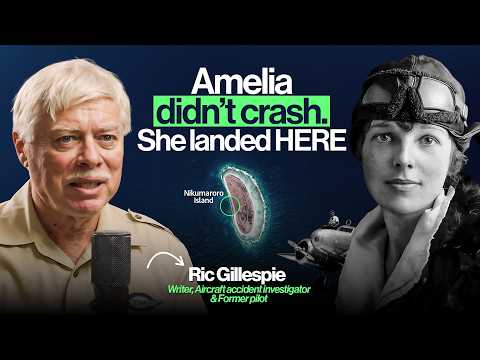
New investigations and evidence suggest that Amelia Earhart did not crash into the ocean but made a safe landing on Gardner Island in 1937. Forensic analysis of radio signals, photographs, artifacts, and skeletal remains support the theory that Earhart survived for some time on the island before her death. The airplane was eventually washed off the reef by tides, explaining why it has never been found.
For nearly 90 years, the fate of Amelia Earhart has been shrouded in mystery and speculation. However, recent investigations led by Rick Gillespie and others have uncovered compelling evidence that Earhart did not crash into the ocean as widely believed. Instead, she made a safe landing on Gardner Island (now Nikumaroro) and survived there for some time.
Rick Gillespie, an airplane insurance investigator and pilot, was initially skeptical about searching for Earhart due to the vastness of the ocean and the small size of the target island. However, in 1988, two retired military navigators presented a theory based on Earhart's last known radio transmissions and navigational lines of position. They suggested that Earhart likely landed on Gardner Island, a place that had not been thoroughly searched.
The U.S. Navy had indeed sent a battleship with float planes to Gardner Island shortly after Earhart's disappearance, but they found no airplane. Instead, they observed signs of recent habitation on the island, which was uninhabited since 1892. This observation was dismissed at the time, and the island was crossed off the search list.
In 1937, a British colonial expedition to Gardner Island took photographs of the western shoreline, primarily focusing on the wreck of the SS Norwich City, a freighter that had run aground in 1929. In 2010, forensic imaging expert Jeff Glickman analyzed one of these photographs and identified a man-made object protruding from the reef.
Further analysis revealed that this object was the landing gear of a Lockheed Model 10 Electra, the same model Earhart was flying. This photograph was taken three months after Earhart's disappearance, strongly indicating that her airplane had landed safely on the reef.
A significant body of evidence comes from radio distress calls heard for nearly a week after Earhart's disappearance. These signals were picked up by professional government operators in the Pacific and by ordinary citizens across North America. The transmissions included a woman's voice, sometimes unintelligible, and were heard at times when Earhart's plane was presumed to be out of fuel.
The Coast Guard cutter Itasca, which was coordinating Earhart's flight, did not know that Fred Nunan, a navigator, was on the plane. Radio logs recorded unintelligible female voices after Earhart's last confirmed transmission, suggesting she was alive and transmitting from a grounded plane.
Lockheed, the airplane manufacturer, noted that if these transmissions were genuine, the airplane could not be in the water because the radios would be wet and inoperable. The plane must have been on land with its wheels down, running the right-hand engine to recharge the radio batteries.
The Navy initially searched the open ocean, assuming Earhart had crashed into the water. However, Admiral Murphin suggested the plane might be on one of the Phoenix Islands, including Gardner Island. The USS Colorado, a battleship with three float planes, was sent from San Francisco to search Gardner Island.
When the float planes arrived, the tide was high, and the reef where Earhart had landed was submerged, making the airplane invisible. The planes saw only surf and no sign of the aircraft or Earhart. The rising tides had washed the airplane off the reef into the ocean.
Evidence suggests Earhart survived on Gardner Island for possibly up to two months. Remains of a baby turtle were found, indicating she might have hunted local wildlife for food. The island's terrain made it difficult to be seen from the air, especially if Earhart was away from the beach or hidden by dense vegetation.
The island was home to aggressive strawberry hermit crabs and large coconut crabs, which could have scavenged remains. Earhart likely died a peaceful death, possibly from dehydration, injury, or protein poisoning due to a limited diet.
Several artifacts linked to Earhart were found on Gardner Island, including remnants of freckle cream, a bone-handled double-bladed jack knife, and a Talon zipper pull dating between 1933 and 1936. These personal items align with what Earhart might have carried.
In 1940, British colonial officer Gerald Gallagher discovered partial skeletal remains, a woman's shoe, and other items on the island. The bones were initially analyzed by Dr. Hoodless in Fiji, who mistakenly identified them as belonging to a short, stocky male, unaware that Earhart had a male companion, Fred Nunan.
Modern forensic anthropologists have re-examined the evidence, comparing bone measurements with photographs of Earhart. The analysis concluded with a 99.28% probability that the remains were Earhart's.
Despite extensive searches, including a $2 million expedition in 2012 led by Bob Ballard, Earhart's airplane has never been found. Rising tides and surf likely tore the plane apart and washed it into the ocean. Pieces of airplane skin and metal have been found on the island, showing signs of human modification, but no intact wreckage.
Satellite images analyzed by Purdue University and the Archaeology Legacy Institute have been inconclusive, with some supposed airplane wreckage identified as natural debris like dead pandanus trees.
There has been speculation about a government cover-up regarding Earhart's fate. A classified report from the time was withheld to protect Earhart's reputation and avoid political fallout. This report remained secret until 1982.
Earhart's husband, Putnam, edited and published a book portraying her disappearance as a tragic accident, which shaped much of the public's perception.
The accumulated evidence from photographs, radio transmissions, artifacts, and forensic analysis strongly supports the conclusion that Amelia Earhart survived her final flight, landed safely on Gardner Island, and lived there for some time before her death. The mystery of her disappearance is closer to being solved, revealing a story of survival, resilience, and tragedy.
Rick Gillespie's book, One More Good Flight, details this 34-year investigation and serves as a definitive work on Earhart's disappearance.
This investigation not only sheds light on a historic mystery but also teaches valuable lessons on critical thinking and the pursuit of truth.



















