
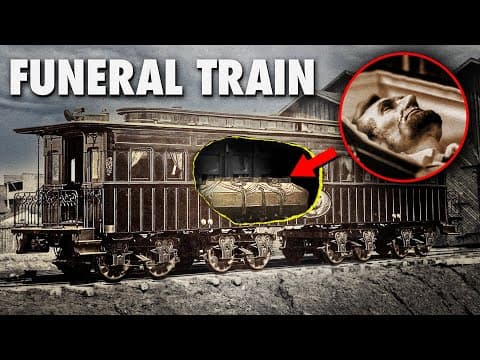
This blog post explores the history of funeral trains in America, from their origins in the 19th century to their role in national mourning for figures like Abraham Lincoln and George H.W. Bush. It details how these trains became symbols of respect and remembrance, highlighting significant journeys and the evolution of this unique tradition.
In the 19th century, urban centers like London faced a pressing issue: cemeteries were overflowing, diseases were rampant, and funerals had evolved from intimate local affairs into logistical challenges. The solution came in the form of rail transport. In 1854, the London Necropolis Railway began a new tradition by transporting bodies and mourners from the city to expansive new burial grounds in the countryside using dedicated funeral trains. This innovation would soon cross the Atlantic, leading to a uniquely American ritual.
As cities expanded and populations surged, the traditional methods of handling the dead became untenable. In London, the mid-19th century saw burial sites overwhelmed, prompting Parliament to intervene. The London Necropolis Railway was established to address this crisis, providing a daily service that transported coffins and mourners to Brookwood Cemetery. This service was not merely symbolic; it was a necessary infrastructure that reflected the social hierarchies of the time, with separate cars for different classes of mourners.
In the United States, the concept of funeral trains gained prominence during the Civil War, where long-distance trains were used to transport fallen soldiers home. However, it was the assassination of President Abraham Lincoln in 1865 that transformed funeral trains into a national symbol of mourning.
Abraham Lincoln was assassinated on April 14, 1865, just days after the Civil War ended. His death marked the beginning of a national reckoning, and his funeral train, known as the Lincoln Special, became a mobile cathedral. The train traveled 1,654 miles from Washington, D.C., to Springfield, Illinois, stopping in major cities along the way for public viewings.
The train consisted of nine cars, including the presidential car, United States, and the casket of Lincoln's son Willie, who had died three years earlier. The journey was a somber procession, with crowds gathering to pay their respects. In cities like Buffalo and New York, tens of thousands of mourners lined the streets, creating a powerful atmosphere of collective grief.
William H. Gold, the conductor of the Lincoln Special, described the emotional scene as the train departed Washington, with crowds gathering even before sunrise. The train's itinerary was published in advance, allowing people from towns along the route to gather and honor the fallen president, even if the train did not stop there.
Upon arriving in Springfield on May 3, 1865, Lincoln was laid to rest at Oak Ridge Cemetery, which remains a significant site for visitors today. The fate of the train itself was less dignified; the United States car was sold and eventually destroyed in a fire, but a replica was later created to commemorate Lincoln's journey.
The tradition of funeral trains continued with the death of Franklin D. Roosevelt on April 12, 1945. His body was transported from Warm Springs, Georgia, to Washington, D.C., and then to Hyde Park, New York. The train used for this journey was a modified rolling command center, with Roosevelt's casket placed in a separate car due to the security features of the presidential car.
As the train traveled through the South, thousands of citizens gathered along the tracks to pay their respects. The train's journey was a poignant reminder of the nation’s grief for its longest-serving president. After the funeral, the train returned to service, continuing to serve the nation in various capacities.
While funeral trains became a distinctly American phenomenon, they were also used in other countries. Winston Churchill's funeral in January 1965 featured a train that transported his coffin from London to his final resting place. The train was meticulously planned and executed, with the locomotive bearing Churchill's name. This marked one of the last instances of a leader being honored by rail in the UK.
The tradition of funeral trains saw a resurgence with the assassination of Robert F. Kennedy in 1968. Following his death, his body was transported by train from New York to Washington, D.C. The journey was marred by tragedy when a northbound train struck several people who had gathered to pay their respects, resulting in fatalities. Despite this, the train continued its somber journey, arriving at Union Station in Washington, D.C., where Kennedy was laid to rest beside his brother.
The concept of funeral trains lay dormant for decades until the passing of George H.W. Bush in 2018. His body was transported by a specially outfitted train from Houston to College Station, Texas. This modern train, painted in the colors of Air Force One, allowed mourners to see the flag-draped coffin as it passed through towns, reviving the tradition in a contemporary context.
Upon arrival at Texas A&M University, Bush was laid to rest alongside his wife and daughter, and the locomotive was later donated to the Bush Presidential Library as a lasting tribute.
The story of funeral trains in America is one of evolution, reflecting societal changes and the ways in which we honor our leaders. From Lincoln's somber procession to Bush's final farewell, these trains have served as a powerful symbol of national mourning and remembrance. As we look back on this unique tradition, we are reminded of the profound impact that these journeys have had on the collective memory of a nation.



















