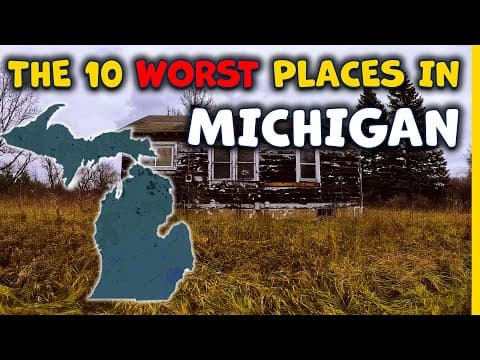
This article explores the 10 worst places to live in Michigan based on crime rates, economic struggles, population decline, and other challenges. From Kalamazoo to Highland Park, each city or area faces unique issues such as high violent crime, poverty, corruption, and economic downturns. Despite some positive aspects, these places struggle with revitalization and growth, reflecting broader challenges in Michigan's urban and suburban landscapes.
Michigan is known for its beautiful beaches, sand dunes, and vibrant cities. However, not all places in Michigan offer the same quality of life. This article examines the 10 worst places to live in Michigan, based on factors such as crime rates, economic decline, population loss, and other social challenges. The list is not just about numbers but also about the lived realities of residents in these areas.
Kalamazoo, often affectionately called "Kalamazoo," has been facing rising crime rates. The violent crime rate stands at 1,284 per 100,000 residents, and the property crime rate is 3,448 per 100,000 residents. This makes Kalamazoo the seventh most dangerous city in Michigan. Residents have a 1 in 78 chance of being a victim of violent crime, which is four times the national average.
Despite these challenges, Kalamazoo has many positive attributes and potential. The county is growing, and the surrounding areas are good places to raise a family. If crime can be addressed, Kalamazoo could become a hip, small-city destination similar to Grand Rapids.
Known for being the home of Kellogg's, Battle Creek struggles with a violent crime rate of 1,122 per 100,000 residents and a property crime rate of 2,532 per 100,000 residents. The city faces economic difficulties, with an 18% poverty rate and a declining population since its peak in 1950.
Battle Creek's economy is heavily reliant on Kellogg's, and it has not diversified much. Only 22% of adults have a bachelor's degree or higher, and the median household income is $51,700. These factors contribute to its ranking as the ninth worst place to live in Michigan.
These areas are essentially extensions of Flint and suffer from high crime and economic decline. Beecher's violent crime rate is 598 per 100,000 residents, and property crime is 1,900 per 100,000 residents. The population has declined by 31% over 25 years.
Mount Morris Township has numerous abandoned retail properties, including a closed Meyer store, indicating economic distress. Both areas face challenges with poverty, crime, and lack of economic opportunities.
These three cities share issues of corruption, high property taxes, poor schools, and declining populations. Examples of corruption include the removal of a police chief in Ecorse due to a cover-up, a school district official in River Rouge sentenced for laundering money, and a former mayor of Inkster jailed for bribery.
Property taxes are high, with some homes paying $5,000 annually on properties valued around $189,000. These factors contribute to residents leaving these communities.
Muskegon Heights is one of Michigan's most dangerous cities, with a violent crime rate of 1,710 per 100,000 residents and a property crime rate of 3,278 per 100,000 residents. The population has dropped from 19,500 in 1960 to under 10,000 today.
The city suffers from high poverty and corruption, creating a cycle of decline. Despite being part of the Muskegon area, Muskegon Heights offers little in terms of safety or economic opportunity.
Detroit has made significant comeback efforts, especially in the downtown area, with new skyscrapers, returning sports teams, and revitalized neighborhoods. However, outside downtown, many areas still face high crime rates, with violent crime over 1,700 per 100,000 residents and property crime over 4,000 per 100,000 residents.
Detroit also struggles with extremely high property taxes, poor city services, and decades of financial mismanagement. The city’s recovery will take generations and sustained effort.
Flint is known nationally for its water crisis, where residents were exposed to high lead levels in tap water. Although the crisis is reportedly over, Flint continues to face economic and social challenges.
The violent crime rate is over 1,200 per 100,000 residents, and the poverty rate is 40.7%. The median household income is $33,000, and there are no traditional public high schools left in the city limits.
Despite some positive developments like the University of Michigan-Flint and downtown improvements, Flint’s future remains uncertain.
Benton Harbor has suffered from segregation, disinvestment, and concentrated poverty. Once a thriving city, it has lost over half its tax base and population, declining from over 19,000 in 1960 to less than 9,000 today.
The city has a poverty rate of 42% and a median household income of $29,600. It also has higher lead concentrations in tap water than Flint did. Despite nearby natural beauty, Benton Harbor faces a bleak economic and social outlook.
Nicknamed "Sag Nasty," Saginaw struggles with high crime, poor schools, and economic decline. The violent crime rate is 2,200 per 100,000 residents, and the poverty rate is 33.7%.
The population has dropped from nearly 100,000 to 42,722, a decline of over 56%. The economy remains heavily reliant on the auto industry, which no longer employs as many people as before.
Saginaw’s future is uncertain, with ongoing population loss and economic challenges.
Highland Park is the worst place to live in Michigan according to this list. Once home to 53,000 people and the headquarters of Chrysler, it now has just 8,250 residents, an 84.4% decline.
The city has a poverty rate of 41% and a median household income of $27,500. It is essentially an enclave within Detroit and may eventually be annexed due to its inability to function independently.
Highland Park’s dramatic collapse is a stark example of urban decline in America.
Michigan’s worst places to live face a combination of high crime, economic decline, population loss, and poor public services. While some cities show signs of hope and revitalization, many continue to struggle with systemic issues.
Understanding these challenges is crucial for policymakers, residents, and potential movers. Michigan’s beauty and potential remain, but addressing these urban and suburban struggles is essential for the state’s overall health and prosperity.
What do you think about this list? Do you agree or disagree? Share your thoughts and experiences to help paint a fuller picture of life in Michigan’s cities.
Peace and hope for Michigan’s future.