
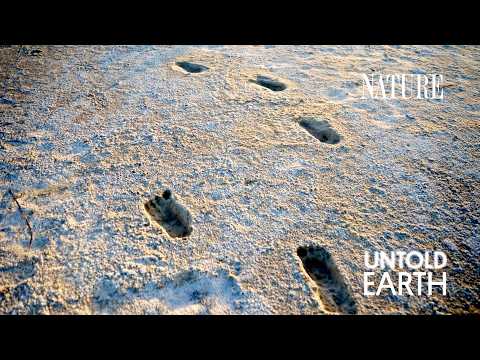
The discovery of ancient human footprints at White Sands National Park suggests human presence in the Americas up to 23,000 years ago, challenging previous historical timelines and revealing interactions with Ice Age megafauna.
In 2009, a groundbreaking discovery was made at White Sands National Park in southern New Mexico. Initially thought to be human footprints, these fossilized traces have since been confirmed to indicate human presence in the Americas during the last Glacial Maximum, far earlier than previously documented. This revelation pushes back the timeline of human habitation in North America by as much as 10,000 years, significantly altering our understanding of early human history in the region.
White Sands is renowned for being the largest gypsum sand dune field in the world. The park's unique geological features have preserved a wealth of ancient footprints, including those of humans and megafauna. The first notable prints discovered in the area date back to 1931, when a giant ground sloth footprint was found, initially mistaken for evidence of Bigfoot. However, it wasn't until the mid-2000s that a more extensive array of prints began to emerge, revealing a complex interaction between ancient humans and the animals of their time.
In 2005 and 2006, after significant flooding in the area, researchers began to uncover a variety of prints along the shores of an ancient lake. Among these were mammoth and camel prints, alongside unmistakable human footprints. The clarity of these prints, made in clay, was astonishing, leading researchers to question the implications of humans coexisting with such large creatures. The prints included those of children playing in the mud and adults interacting with the megafauna, providing a vivid snapshot of life thousands of years ago.
The most compelling evidence of human and animal interaction was uncovered in 2016 and 2017, when researchers found human footprints layered with those of giant ground sloths. This layering confirmed that humans and these extinct creatures were indeed walking the same paths, a finding that has been described as one of the most significant archaeological discoveries in the Americas in recent decades.
The footprints tell a rich story of daily life and interactions. For instance, one notable print depicts a mother carrying her child, slipping in the mud at the same spot where a giant ground sloth also lost its footing. Such details illustrate not only the physical presence of these ancient peoples but also their emotional and social lives, suggesting a deep connection with the environment and the animals they shared it with.
Traditionally, the academic consensus held that humans arrived in the Americas between 12,000 and 14,000 years ago. However, the findings at White Sands have pushed this timeline back to approximately 23,000 years ago. This significant shift challenges long-held beliefs and supports the claims of many Native American tribes who assert that their ancestors have been present in the Americas since time immemorial.
The dating of the footprints has been corroborated by multiple laboratories across the country, confirming the age of the prints through various methods, including the analysis of seeds and pollen layers. The stratigraphy of the area reveals a complex history of wet and dry periods, which has helped researchers understand the environmental conditions that allowed for the preservation of these footprints.
Despite the importance of these findings, the preservation of the footprints is under constant threat. Natural events such as flash floods and drying conditions are eroding the prints, making documentation a priority for researchers. The team has shifted its focus from preservation to thorough documentation, recognizing that many prints may soon be lost forever.
At the heart of this discovery is a profound connection between ancient humans and their environment. The footprints serve as a reminder of our shared humanity, illustrating that regardless of the time period, people have always engaged with their surroundings in similar ways. The joy of children playing in mud or the care of a parent carrying a child transcends time, highlighting the timeless nature of human experience.
The ancient footprints at White Sands National Park not only rewrite the history of human presence in North America but also enrich our understanding of the interactions between early humans and the megafauna of their time. As researchers continue to document these invaluable traces of the past, they emphasize the urgency of preserving these stories before they are lost to time. The footprints are more than just remnants of the past; they are a testament to the enduring connection between humans and the natural world.



















