Aston Martin's difficult start to the 2026 F1 season has led to significant technical staff reshuffling, including the reassignment of key figures like Bob Bell and William Warrell. Meanwhile, Mercedes and Red Bull exploit a new power unit trick within FIA regulations to gain a competitive edge, raising safety and fairness concerns ahead of the Miami Grand Prix.
The 2026 Formula 1 season has kicked off with significant challenges for Aston Martin, leading to major changes within their technical team. Simultaneously, Mercedes has been caught employing a new technical trick with their power unit, sparking controversy and safety concerns. This article delves into the unfolding developments at Aston Martin and the innovative yet contentious strategies being used by Mercedes and Red Bull.
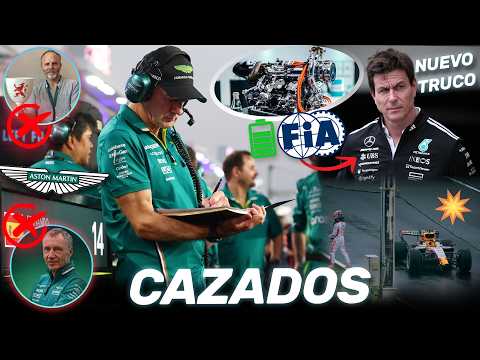
Aston Martin's 2026 season has been described as atrocious, with early struggles already causing repercussions within the team. Motorsport reports indicate that Bob Bell, a high-profile technical executive who joined Aston Martin in early 2024 to strengthen their technical department, has been reassigned away from the Formula 1 project.
Bob Bell was brought in as the Executive Technical Director at Aston Martin's Silverstone base. He played a significant role in the development of the MR25 car, which faced numerous challenges. Bell was also responsible for overseeing the technical transition until Adrian Newey's arrival in March 2025.
Bell is a highly respected senior engineer with extensive experience in Formula 1. He spent around 20 years at Alpine (formerly Renault), where he contributed to the world championship-winning cars of 2005 and 2006 driven by Fernando Alonso. Notably, Bell led the technical group that developed the dominant Mercedes car of 2014 before leaving the team.
Alongside Bell, William Warrell, a senior engineer with nearly 30 years of experience in Formula 1, has also been moved to Aston Martin Performance Technology. Warrell's career includes stints at Arrows, Jordan, Renault, and Force India, and he has been part of the Aston Martin structure for over 15 years. His responsibilities included managing aerodynamic integration, wind tunnel testing, and CFD simulation to ensure accurate data correlation and optimization—areas where Aston Martin has struggled in recent years.
This method of quietly reassigning key personnel is typical for Aston Martin. Similar moves were made with Dan Fallows and others before their eventual departures. The practical effect is that Bell and Warrell, despite their significant roles, have been removed from the Formula 1 project, joining a growing list of senior engineers who have left or been reassigned since the November 2025 restructuring.
Among those who left were Eric Blandin, the Deputy Technical Director, and Akio Haga, Head of Design. Andy Cowell's situation is also under scrutiny, with speculation that he may face a similar fate soon.
Under Adrian Newey's new structural leadership, Aston Martin is dismantling and rebuilding its technical organization to address weaknesses and improve synergy. Jonathan Wheatley is expected to join the team, focusing on the sporting side, although his appointment as Team Principal is not expected until the end of the year due to ongoing negotiations with Audi regarding his gardening leave.
The restructuring is a complex process that requires time to yield results, unlike a football team changing coaches and seeing immediate effects. Aston Martin continues to face challenges with the AMR26 car, but the team is actively defining its final organizational structure.
Testing is ongoing at Suzuka, where Red Bull Racing and Red Bull Powertrains are conducting tire tests with Pirelli. They are evaluating a new super intermediate tire designed for 2027, featuring more grooves to reduce aquaplaning in wet conditions and offering a broader operating window between semi-wet and heavily wet surfaces.
These tests are being conducted with 2026 cars, providing teams with valuable data amid widespread uncertainties.
During testing, Arvin Linblad suffered a crash that severely damaged the VAR03 car, which still bore a special livery. Fortunately, Linblad exited the car uninjured, which is the most important outcome.
A significant revelation from the testing sessions is a new technical trick employed by Mercedes and Red Bull Powertrains involving their power units. This innovation exploits a loophole in the FIA regulations concerning the MGUK (Motor Generator Unit - Kinetic) power delivery during qualifying and race modes.
The FIA mandates that the electrical power delivery from the MGUK must decrease in stepped intervals of 50 kW every second until it reaches zero. However, Mercedes and Red Bull have found a way to reduce the power abruptly from 350 kW to zero in one instant, bypassing the stepped reduction.
This is achieved by using an emergency safety system designed by the FIA to instantly disconnect the electrical part if a problem arises. By exploiting this system, the teams gain a competitive advantage by maintaining maximum MGUK power for a longer period during their flying laps in qualifying.
Although the total energy usage remains the same for all teams, this method allows for better power deployment and a slight lap time improvement, especially on circuits with long full-throttle sections leading to the finish line.
To prevent abuse, the FIA has imposed a 60-second MGUK lockout penalty if this abrupt power cut is used. Teams typically deploy this trick only at the end of their qualifying laps, so the lockout occurs during the cooldown lap, minimizing performance impact.
However, this creates risks during the cooldown lap, as the car runs without MGUK assistance, making it difficult for the turbocharged internal combustion engine to stay operational. Drivers have experienced engine stalls and erratic behavior, as seen with Alexander Albon, Max Verstappen, and other drivers during free practice sessions.
Ferrari has raised concerns about this practice, labeling it an abuse of FIA regulations and a safety hazard. They have formally requested clarifications from the FIA regarding the legality and future allowance of this technique, especially ahead of the Miami Grand Prix.
The FIA is expected to review the situation and potentially implement changes to prevent exploitation of this emergency system for performance gains.
The 2026 Formula 1 season is already shaping up to be a period of intense technical evolution and strategic maneuvering. Aston Martin is undergoing significant internal changes to address its early-season difficulties, while Mercedes and Red Bull continue to push the boundaries of the regulations to gain competitive advantages.
As the season progresses, the impact of these developments on team performances and regulatory responses will be critical to watch. The balance between innovation, fairness, and safety remains a delicate one in the pinnacle of motorsport.
What are your thoughts on Aston Martin's restructuring and the new power unit trick by Mercedes and Red Bull? Share your opinions in the comments below.