
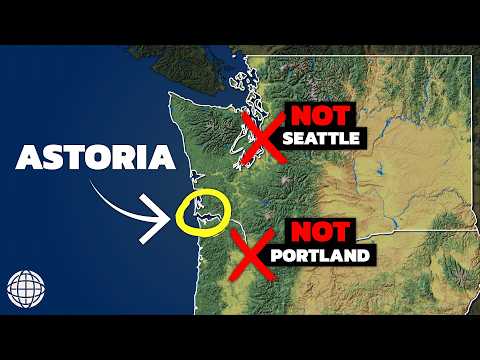
Astoria, Oregon, once envisioned as the Pacific Northwest's major city, failed to thrive due to geographic challenges, lack of rail access, and competition from Seattle and Portland. Despite its strategic location at the Columbia River's mouth, natural obstacles and economic decisions led to its decline, leaving it a small town today.
In the Pacific Northwest, Seattle, Washington, and Portland, Oregon, are recognized as the two major cities. However, the region once had aspirations for a different urban center at the mouth of the Columbia River—Astoria, Oregon. This blog post explores the fascinating history of Astoria and why it never became the major city it was intended to be.
On paper, the Columbia River region appeared to have all the necessary ingredients for a thriving settlement. It features a large body of water that allows ships to navigate in and out, plenty of peninsulas with flat terrain for development, and abundant forests for timber. Despite these advantages, the reality was starkly different.
Unlike the Golden Gate, which provides a relatively straightforward passage to San Francisco Bay, the Columbia River Bar is notorious for its turbulent waters and unpredictable waves. The interplay of river currents, ocean swells, and tidal forces creates a hazardous environment, leading to the nickname "the graveyard of the Pacific" due to nearly 2,000 shipwrecks in the area.
Astoria's story begins with the fur trade, which was pivotal in early exploration of the Pacific Northwest. Founded in 1811 by John Jacob Astor of the Pacific Fur Company, Astoria was strategically located for maritime trade and access to the interior fur trapping regions. Astor aimed to establish a permanent American presence in the region, linking the Pacific Northwest with markets in China and the Eastern United States.
The British, through the Hudson Bay Company, also sought to dominate the Pacific Northwest. They established Fort Vancouver in 1825, which became the center of British operations in the region. The competition between Astoria and Fort Vancouver was intense, especially during the War of 1812 when the British temporarily took control of Astoria, renaming it Fort George.
Despite its promising start, Astoria's position as a major city was short-lived. Several factors contributed to its decline:
Astoria's location, while advantageous for maritime access, posed significant limitations. The rugged terrain and narrow coastal strip restricted expansion, and the Columbia River Bar made it difficult to establish a reliable shipping hub, unlike San Francisco.
The arrival of railroads in the late 1800s was a turning point for the region. Railroads connected Seattle, Tacoma, and Portland to the Eastern United States, while Astoria remained isolated due to the high costs of constructing a line through the coastal mountains. The Northern Pacific Railway stopped at Gold Oregon, leaving Astoria without the vital transportation infrastructure that propelled its competitors.
Portland's growth was fueled by its proximity to the fertile Walla Walla Valley, which attracted settlers and businesses. In contrast, Astoria lacked access to this agricultural wealth and the transportation infrastructure to connect to larger markets. Seattle's sheltered harbor and its role as a staging ground during the Klondike Gold Rush further solidified its position as a major trade hub.
Astoria faced one last devastating event—the Great Astoria Fire of 1922, which destroyed much of the downtown area. Although the city attempted to recover through tourism and cultural heritage efforts, it could not compete with the economic power of Portland and Seattle.
Today, Seattle and Portland lead the Pacific Northwest with populations of 4 million and 2.5 million, respectively, while Astoria has dwindled to just 10,000 residents. With a few twists in history, Astoria could have been a major city in the region. This exploration of Astoria's rise and fall highlights the intricate interplay of geography, economics, and historical events that shape urban development.



















