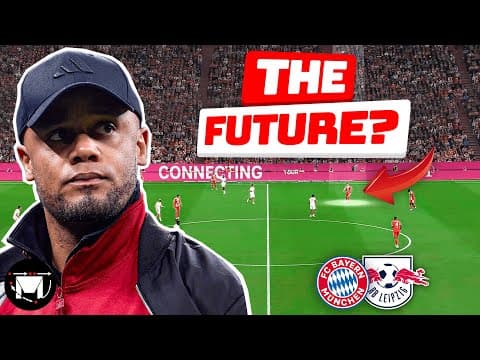
Bayern Munich's season opener against Leipzig showcased tactical innovations under Kompany, highlighting challenges faced by possession teams and potential evolutions in football strategy. Despite a strong attack, defensive vulnerabilities were evident, indicating areas for improvement as they aim for Champions League success.
Bayern Munich's emphatic victory over RB Leipzig in the season opener was not just a display of skill but also a showcase of tactical evolution under the guidance of their new manager, Vincent Kompany. While the scoreline suggested dominance, the match revealed underlying issues that possession-based teams often encounter, particularly in high-stakes competitions like the Champions League.
In modern football, possession teams typically employ formations such as 4-3-3 or 3-2-5, aiming to overload the midfield. However, they increasingly face opponents willing to cede space across the pitch, except for critical central zones. Leipzig's strategy involved a compact 4-4-2 formation, where the front two players marked Bayern's pivots, allowing their own midfielders to drop deeper and neutralize threats between the lines.
This tactical setup posed a significant challenge for Bayern, as it limited their influential midfielders' ability to receive the ball in dangerous areas. Consequently, the center-backs bore the brunt of ball distribution responsibilities, which often slowed down Bayern's attacking rhythm.
Kompany's response to this tactical conundrum was innovative. He instructed Joshua Kimmich, Bayern's metronome, to frequently shift to the flanks, particularly to the right center-back position. This movement allowed Leon Goretzka to push into the right half-space, while Stanišić temporarily occupied a pivot role. This adjustment is noteworthy as it highlights a potential trend in European football: the emergence of space outside the center forwards, which could be exploited by influential playmakers.
Kimmich's movement into these areas enabled him to dictate play effectively, leading to him recording the most touches and passes on the pitch. His ability to keep the ball moving and find teammates down the right flank was crucial. At one point, Kimmich's positioning almost led to an opening goal, showcasing the effectiveness of this tactical shift.
Despite their attacking prowess, Bayern's defensive structure revealed vulnerabilities. As Kimmich advanced higher up the pitch, he often reverted to his midfield role, leaving only two center-backs to defend against Leipzig's transitions. This created significant gaps behind the inverted full-backs, which Leipzig exploited on several occasions, indicating a need for improvement in Bayern's defensive organization.
Bayern's attacking fluidity was a highlight of their performance. The team demonstrated remarkable positional rotations and formation fluidity. In deeper phases, Kimmich's role shifted, allowing Serge Gnabry and Harry Kane to operate as a front two. This dynamic movement caused problems for Leipzig's defense, as both players were adept at dropping deep or making runs behind the defensive line.
When Bayern advanced the ball, they transitioned from a traditional 3-2-5 or 2-3-5 formation to a more compact 2-2 setup in the buildup. This allowed Stanišić to push higher, creating overloads in critical areas, particularly zone 14. The presence of a front five, with players willing to run in behind, posed a constant threat to Leipzig's backline.
One of the drawbacks of Leipzig's narrow 4-4-2 defensive shape was the potential for Bayern's wide players to exploit space. Players like Goretzka and Oise took advantage of this, arriving late into crossing positions and creating dangerous opportunities. This aspect of Bayern's play was crucial in maintaining their attacking threat throughout the match.
Bayern Munich's season opener against RB Leipzig was a statement of intent, showcasing both tactical innovation and areas for improvement. While their attacking strategy under Kompany appears promising, defensive vulnerabilities must be addressed to achieve their long-term objectives, particularly in the Champions League. As the season progresses, it will be interesting to see how Kompany adapts his tactics to overcome these challenges and whether the trends observed in this match will become a staple of modern football strategy.