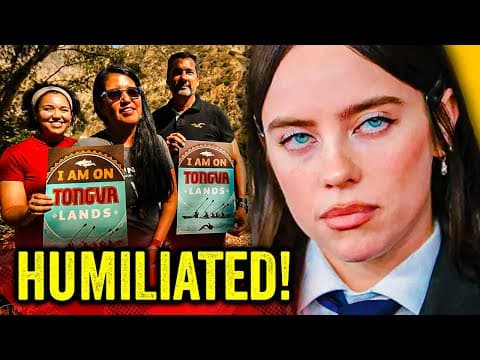
At the recent Grammy Awards, Billie Eilish declared "No one is illegal on stolen land," sparking applause but quickly facing backlash when it was revealed she lives on land claimed by the Tongva tribe, surrounded by a wall and with a restraining order against trespassers. This incident highlights Hollywood's hypocrisy and historical misunderstandings about land ownership, contributing to the industry's ongoing financial and cultural decline.
At the recent Grammy Awards, pop star Billie Eilish made a bold statement during her acceptance speech for Song of the Year, declaring, "No one is illegal on stolen land." The crowd, including many celebrities and even a Supreme Court Justice, applauded enthusiastically. However, this moment intended to showcase woke activism quickly unraveled, exposing a glaring contradiction and sparking widespread criticism.
Billie Eilish, 24, accepted her award wearing an "Ice Out" pin and delivered her message to a room full of millionaires. The phrase "No one is illegal on stolen land" was meant to highlight issues surrounding immigration and indigenous rights. The audience's applause suggested agreement and admiration for her courage and insight.
However, the statement did not withstand scrutiny for long.
Within hours, it was revealed that Billie Eilish lives in a multi-million dollar mansion in Los Angeles, situated on land historically owned by the Tongva tribe, also known as the first Angelenos. The Tongva tribe considers this land their ancestral territory.
Adding to the irony, Eilish's mansion is surrounded by a wall, effectively restricting access to the land she claims was stolen. Furthermore, she has a restraining order against someone who trespassed on her property. This starkly contrasts with her public statement that "no one is illegal on stolen land."
The Tongva tribe confirmed to Fox News that Eilish has never reached out to them regarding her property, highlighting a lack of acknowledgment or reconciliation.
The hypocrisy did not go unnoticed. Social media erupted with criticism, calling out the virtue signaling fail. Many pointed out that working-class Americans, who cannot afford walls or armed guards, bear the brunt of issues related to illegal immigration, such as crime and strained public services.
Critics argue that celebrities like Eilish promote revolutionary ideas from a place of safety and privilege, while ordinary citizens face the consequences.
The "stolen land" narrative is historically and intellectually flawed. An insightful essay by Jeff Finn Paul, associate professor of history at Leiden University, titled The Myth of the Stolen Country, provides a detailed rebuttal.
Hollywood's embrace of woke ideology, exemplified by Eilish's speech, is seen by many as hypocritical and disconnected from reality.
The disconnect between celebrity activism and everyday American experiences fuels resentment and declining support for Hollywood.
Billie Eilish's "No one is illegal on stolen land" speech intended to make a powerful statement but instead exposed the contradictions and hypocrisy prevalent in Hollywood's woke culture. The historical inaccuracies of the "stolen land" argument, combined with the personal circumstances of Eilish's property, have led to widespread criticism.
This incident reflects broader issues within the entertainment industry and society, where virtue signaling often clashes with lived realities and historical facts. As Americans grow weary of celebrity moralizing, Hollywood faces a reckoning that may reshape its cultural influence.
In a brief but important diversion, recent research highlights the rising incidence of early-onset Alzheimer's disease, now affecting younger adults more frequently. Chronic inflammation and oxidative stress, often linked to gut health, are key drivers of neurodegeneration.
Studies suggest that consuming kimchi, rich in bioactive compounds, may improve cognitive function and reduce Alzheimer's risk by targeting amyloid beta plaques. Products like Kimchi One offer these benefits in convenient capsules.
This health insight underscores the importance of addressing root causes rather than just symptoms in chronic diseases.
This comprehensive overview captures the full context and implications of Billie Eilish's controversial Grammy speech and the broader cultural and historical issues it touches upon.