
This blog post explores the economic strategies employed by Nazi Germany to finance its military ambitions, detailing the manipulation of currency, the role of industrialists, and the systemic exploitation of occupied territories, ultimately revealing how the regime's obsession with war reshaped the economy and society.
The rise of Nazi Germany under Adolf Hitler was not just a political phenomenon; it was also an economic revolution that sought to redefine the very fabric of German society. From the moment Hitler launched his military campaigns across Europe on September 1, 1939, the Nazi regime was driven by a singular obsession: war. This blog post delves into the intricate economic strategies that enabled the Nazis to finance their military ambitions, revealing how they manipulated currency, exploited labor, and plundered occupied territories.
When Hitler came to power on January 30, 1933, Germany was in dire straits. The country was reeling from the effects of the Great Depression, with a standard of living comparable to that of lower-middle-income countries today. Unemployment soared to six million, and the economy was heavily indebted, particularly to the United States. The Treaty of Versailles had further crippled Germany, limiting its military capabilities and imposing reparations that the nation could not afford.
To wage war, Germany needed a robust military, but the Treaty of Versailles had restricted its army to just 100,000 men. One of Hitler's first actions was to rebuild the military, which required substantial funding. The Minister of the Economy and President of the Reichsbank, Hjalmar Schacht, devised a clever scheme known as the MIFO bills. These bills were essentially a form of credit issued by a fictitious company, allowing the regime to finance rearmament without immediate payment.
The MIFO bills were a financial innovation that allowed the Nazi regime to mask its rearmament efforts from the outside world. They were issued to companies producing weapons, functioning as a parallel currency within the arms industry. This system restored confidence among industrialists and provided the liquidity necessary for the production of military equipment. By 1934, less than half of the four billion Reichsmarks invested in rearmament appeared in the official budget, demonstrating the effectiveness of this covert financing method.
While the Nazi regime initially faced skepticism from industrialists wary of upsetting the Allies, the promise of rearmament soon won them over. Major industrial firms like Krupp and IG Farben began to benefit from government contracts, leading to a significant economic upturn. However, the regime's social policies, including the banning of trade unions and the introduction of the German Labor Front, shifted the balance of power in favor of employers.
The Nazi regime touted its economic recovery as a miracle, with propaganda highlighting the construction of motorways and housing. By 1938, full employment was achieved, but this prosperity was not evenly distributed. Many working-class households spent a significant portion of their income on basic necessities, while the regime encouraged saving for consumer goods that were often unattainable.
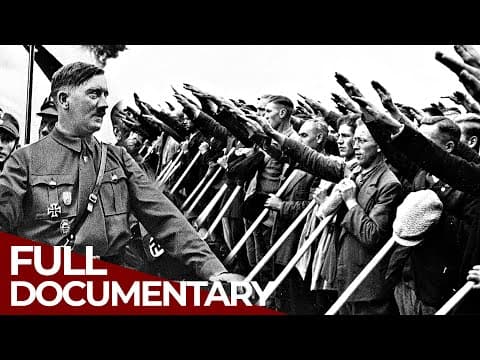
In 1935, Hitler reintroduced conscription, marking a shift towards open militarization. The regime organized grand parades and public displays of military might, fostering a sense of national pride. However, this militarization came at a cost, as resources were increasingly diverted from civilian needs to the arms industry.
As the war loomed, the Nazi economy faced challenges in sustaining its rearmament efforts. Schacht's warnings about the unsustainable nature of the MIFO bills led to a power struggle within the regime. Ultimately, Hermann Göring was appointed to oversee the Second Four-Year Plan, which aimed for economic self-sufficiency. This plan involved significant public investment in synthetic fuel and rubber production, despite the high costs associated with these initiatives.
The Nazi regime's economic ideology was deeply intertwined with its anti-Semitic beliefs. The regime viewed Jews as the embodiment of capitalist exploitation and sought to exclude them from the economy. This led to systematic plunder of Jewish property and wealth, particularly following events like Kristallnacht in 1938, which further fueled the regime's financial resources.
As World War II began with the invasion of Poland on September 1, 1939, the Nazi economy was still not fully prepared for sustained military conflict. Despite significant rearmament, the German military was only partially motorized, and munitions were in short supply. The regime relied heavily on credit and plunder from occupied territories to finance its war efforts.
The Nazi regime systematically looted resources from occupied countries, with France being a significant source of funds. Approximately one-third of the German war expenses were financed through the exploitation of these territories. This included the confiscation of food, raw materials, and industrial assets, which were essential for sustaining the war economy.
The economic strategies employed by Nazi Germany were characterized by manipulation, exploitation, and a relentless pursuit of military power. The regime's ability to finance its ambitions through innovative financial schemes, industrial collaboration, and the systematic plunder of occupied territories reveals the dark underbelly of its so-called economic miracle. As the war progressed, the Nazi economy became increasingly reliant on corruption and theft, ultimately leading to a chaotic and unsustainable war effort. The legacy of this economic machinery serves as a stark reminder of how ideology can distort economic practices and societal values.



















