Brandon Sanderson reflects on the definition of art, addressing Roger Ebert's claim that video games aren't art, and discusses the rise of AI-generated art. He argues that art is defined by human experience and transformation through creation, not just the final product. Sanderson expresses concern about AI art's inability to grow or feel, emphasizing that true art is a deeply human process.
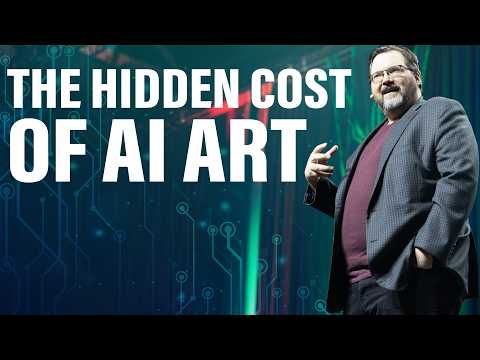
In his keynote speech, renowned author Brandon Sanderson delves into the complex questions surrounding the definition of art and the evolving role of artificial intelligence (AI) in creative fields. Reflecting on a controversial claim made by film critic Roger Ebert in 2010—that video games can never be art—Sanderson uses this as a springboard to explore broader philosophical questions about what art truly is and why humans create it.
In April 2010, Roger Ebert famously stated that "Video games can never be art." This assertion sparked widespread debate, with many dismissing Ebert as out of touch. However, Sanderson acknowledges that Ebert was an intelligent and articulate scholar whose argument had some depth beyond the clickbait headline.
Ebert's core argument was that video games focus on mechanics and winning rather than aesthetic enjoyment. He viewed games as inherently commercial products, akin to toasters, and therefore not art at their core. Sanderson disagrees profoundly with this perspective, emphasizing that the mechanics of games themselves can be an artistic medium. Video games enable storytelling in ways unique to their interactive nature, where the emotions tied to winning and overcoming challenges contribute to the artistic experience.
Sanderson shifts focus to the contemporary surge of large language models and generative AI, which raise new questions about art's nature. Despite his reservations about AI's impact on writing and art, he recognizes the importance of engaging with these questions.
He cites recent examples such as "Walk My Walk," an AI-generated song that topped Billboard's digital country songs chart, and a test conducted by author Mark Lawrence where AI-generated prose was indistinguishable from that written by human authors. These developments demonstrate that AI can already imitate certain artistic expressions convincingly, forcing society to reconsider what constitutes art.
Sanderson draws parallels to past skepticism about emerging art forms. When prose storytelling gained popularity over poetry, some critics dismissed it as lesser art. Photography was once criticized for merely capturing reality rather than creating art. Early film faced similar dismissals as lowbrow entertainment. In hindsight, these critiques were proven wrong, suggesting that current doubts about AI art might also be misplaced.
Despite acknowledging valid concerns about AI's economic and environmental impacts and the ethical issues surrounding training models on copyrighted works, Sanderson explains that his resistance to AI art runs deeper.
He reflects on the symbolic story of John Henry, the American folk hero who competed against a steam-powered drill. Although John Henry ultimately lost and died from exertion, his story symbolizes human resilience and the choice of what victory means. Sanderson uses this metaphor to assert that art is defined by human values and choices.
For Sanderson, art is not merely the finished product—be it a story, painting, or sculpture—but also the transformative process of creation. The emotions, struggles, and growth experienced by the artist during creation are integral to what makes art meaningful.
He argues that AI, no matter how sophisticated, cannot undergo this transformation. AI does not learn, grow, or care about its creations. It cannot be changed by the act of creating. Therefore, while AI can produce works that mimic art, it cannot be an artist.
Sanderson references the character Data from "Star Trek: The Next Generation," an android who strives to understand and create art despite lacking human emotions. He expresses admiration for Data's efforts, suggesting that if AI were truly capable of experiencing and growing through art, it might be worthy of artistic recognition.
However, current AI lacks this capacity. Sanderson concludes that humans retain the power in defining and creating art because art is fundamentally a human endeavor tied to our experiences and emotions.
Brandon Sanderson's keynote speech invites us to reconsider what art means in an age of advancing technology. While AI challenges traditional notions by producing convincing imitations, true art remains rooted in human transformation and emotional engagement. As we navigate this evolving landscape, Sanderson encourages a thoughtful dialogue about the essence of creativity and the irreplaceable role of the human artist.
This exploration underscores the enduring question: What is art, and why do we make it? For Sanderson, the answer lies in the human spirit and the profound changes that creation brings to both artist and audience.