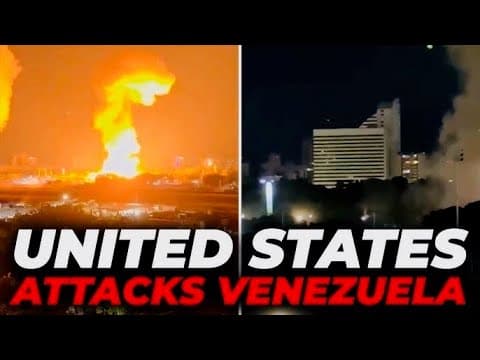
The United States, under President Trump, has launched a military operation in Venezuela, abducting President Nicolas Maduro and his wife. This unprecedented act involves airstrikes in Caracas, legal indictments in New York, and raises serious questions about international law and sovereignty. The situation is chaotic and marks a significant escalation in US-Venezuela relations.
In a shocking and unprecedented development, the United States has launched a military operation against Venezuela, resulting in the abduction of Venezuelan President Nicolas Maduro and his wife. This event marks a significant escalation in US-Venezuela relations and raises serious questions about international law, sovereignty, and the future of the region.
The last 12 hours have been marked by rapid and dramatic developments:
The operation involved a large-scale bombing raid on Caracas, targeting multiple locations. Witnesses describe the scene as chaotic and terrifying, with explosions heard throughout the city. The targets of the strikes remain largely unclear, but it is evident that the operation was extensive and aggressive.
President Trump stated that the operation was conducted in conjunction with U.S. law enforcement and that Maduro and his wife were captured and flown out of the country to stand trial in New York. However, the legality and legitimacy of this action are highly questionable.
The abduction of a sitting president of a sovereign nation and his subsequent indictment in a U.S. court is unprecedented. Questions arise about the evidence supporting the charges against Maduro and whether a fair trial can occur under these circumstances.
Critics argue that this act violates international law and sets a dangerous precedent. If the United States can kidnap and try a foreign leader, it opens the door for other nations to do the same to U.S. leaders, undermining global diplomatic norms.
Senator Mike Lee defended the operation by claiming it falls under the president's inherent authority to protect U.S. personnel, citing Article II of the Constitution. However, this justification has been met with skepticism and criticism, as the operation appears to be an offensive act rather than a defensive one.
Despite the gravity of the situation, President Trump reportedly continued his golf game at Mar-a-Lago, opting not to use the Situation Room or take shelter in a bunker. He announced a press conference to be held at Mar-a-Lago to provide further details.
This casual approach to a major military operation has drawn criticism and raised concerns about the administration's handling of foreign policy and national security.
The operation has sparked intense debate and controversy. Supporters claim it is a decisive action against a regime they view as illegitimate and criminal. Opponents condemn it as an illegal invasion and abduction that violates international law and endangers regional stability.
The situation remains fluid, with many unanswered questions about the future of Venezuela, the fate of Maduro and his wife, and the broader implications for U.S. foreign policy.
The United States' military operation in Venezuela and the abduction of President Nicolas Maduro represent a dramatic and dangerous escalation in international relations. This unprecedented act challenges established norms of sovereignty and international law, raising profound questions about the future of diplomacy and conflict in the region.
As the situation develops, the world watches closely, hoping for a resolution that avoids further violence and instability.
This article has summarized the key events and implications of the recent U.S. military action in Venezuela based on the latest available information.