
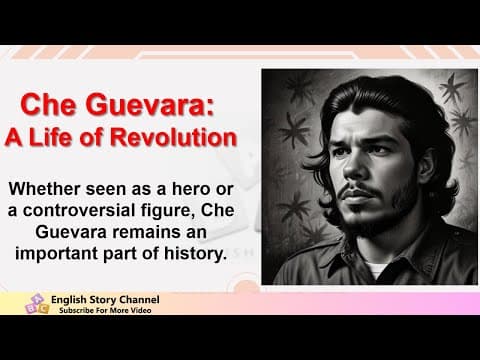
This blog post explores the life of Che Guevara, from his early years in Argentina to his pivotal role in the Cuban Revolution and his enduring legacy as a symbol of rebellion and social justice. It examines his motivations, leadership qualities, and the controversies surrounding his methods and ideology.
Ernesto Che Guevara, born on June 14, 1928, in Rosario, Argentina, is a figure synonymous with revolution and social justice. His journey from a young boy with a passion for reading to a key player in the Cuban Revolution is marked by a deep commitment to fighting inequality and imperialism. This blog post delves into his life, his revolutionary activities, and the complex legacy he left behind.
Che Guevara was the eldest of five children in a family that moved frequently across Argentina. Despite suffering from asthma, he was active in sports and developed a love for reading, particularly books on politics, history, and adventure. He pursued a medical degree at the University of Buenos Aires, motivated by a desire to help the poor.
In 1952, Guevara embarked on a transformative motorcycle trip across South America with his friend Alberto Granado. This journey exposed him to the harsh realities of poverty and injustice, igniting his passion for social change. He documented his experiences in a diary, which later became known as "The Motorcycle Diaries."
After his travels, Guevara moved to Guatemala, where he witnessed the U.S.-backed overthrow of a government attempting to implement reforms for the poor. This event fueled his disdain for imperialism. In Mexico, he met Fidel Castro, who was planning to overthrow Cuban dictator Fulgencio Batista. Guevara joined Castro's revolutionary movement, marking the beginning of his significant role in the Cuban Revolution.
In 1956, Guevara, Castro, and a small group of rebels landed in Cuba to initiate their fight against Batista's regime. They faced numerous challenges, including hiding in the mountains and engaging in guerrilla warfare. Guevara's bravery and leadership were instrumental in the revolution's success, culminating in Batista's flight from Cuba in 1959.
Following the revolution, Guevara held several important positions in the new government, including head of the National Bank and Minister of Industry. He focused on improving education and healthcare, advocating for a strong and equitable society. Guevara also authored numerous books and speeches promoting socialism and revolutionary ideals.
Guevara's vision extended beyond Cuba. In 1965, he left to support revolutionary movements in other countries, first in the Congo and later in Bolivia. Unfortunately, these missions were unsuccessful, and he was captured by the Bolivian Army, aided by the CIA, and executed on October 9, 1967.
Che Guevara's life and actions have left a profound impact on the world. He is celebrated as a symbol of rebellion and change, with his iconic image becoming synonymous with revolutionary movements. However, opinions on his legacy are divided. Supporters admire his courage and commitment to social justice, while critics point to his use of violence and controversial policies.
Guevara's words continue to resonate:
These quotes reflect his beliefs in personal transformation, collective action, and the importance of fighting against injustice.
Guevara and Castro's relationship was pivotal in the Cuban Revolution. They met in Mexico in 1955, and Guevara quickly became one of Castro's most trusted allies. Together, they led the guerrilla campaign against Batista, ultimately achieving victory in 1959. After the revolution, Guevara held significant government positions, but their ideological differences regarding governance and economic policies sometimes led to tension.
Che Guevara's life was characterized by a relentless pursuit of justice and equality. His story serves as a powerful reminder of the struggles for freedom and the complexities of revolutionary ideals. Whether viewed as a hero or a controversial figure, Guevara remains an enduring symbol of resistance and change in history.



















