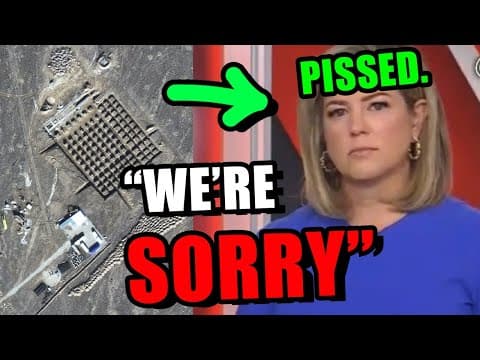
CNN is under investigation for publishing a story based on a leaked intelligence assessment that downplayed the effectiveness of U.S. military strikes on Iran's nuclear facilities. The report contradicts statements from President Trump and his administration, leading to accusations of media bias and misinformation.
In recent days, CNN has found itself at the center of controversy following the publication of a story that cites a leaked intelligence assessment regarding U.S. military strikes on Iranian nuclear facilities. This incident has sparked a heated debate about media integrity, the reliability of intelligence sources, and the ongoing tensions between the U.S. and Iran.
The controversy began when CNN reported that, according to three sources, an early U.S. intelligence assessment indicated that the military strikes on three Iranian nuclear facilities did not destroy the core components of Iran's nuclear program. Instead, the assessment suggested that the strikes only set back Iran's nuclear capabilities by a few months. This information was reportedly based on a battle damage assessment conducted by the U.S. Central Command (CENTCOM) shortly after the strikes took place.
The assessment in question was produced by the Defense Intelligence Agency (DIA), which is the Pentagon's intelligence arm. It was characterized as an early evaluation, with the intelligence community still in the process of gathering comprehensive data about the strikes' impact. According to the assessment, while there was significant damage to above-ground structures, the core components of Iran's nuclear program remained largely intact.
In response to CNN's report, White House Press Secretary Carolyn Levit publicly disagreed with the assessment, labeling it as "flat-out wrong." She criticized the leak, attributing it to an anonymous source within the intelligence community and suggesting that it was an attempt to undermine President Trump and the military personnel involved in the operation. Levit emphasized that the strikes were executed flawlessly and resulted in total obliteration of the targeted facilities.
This narrative stands in stark contrast to statements made by President Trump and Secretary of Defense Pete Hegith, both of whom claimed that the strikes had decisively crippled Iran's nuclear capabilities. Trump asserted that the facilities were completely destroyed, while Hegith echoed this sentiment, stating that the bombing campaign had effectively obliterated Iran's ability to develop nuclear weapons.
The incident has reignited discussions about media bias, particularly regarding how mainstream outlets like CNN report on military actions and foreign policy. Critics argue that CNN's reliance on foreign intelligence and its willingness to publish information that aligns with anti-Trump narratives reflects a broader trend of media bias against the current administration.
The leak of the intelligence assessment has raised questions about the motivations behind such disclosures. Some commentators suggest that the leak serves to promote a narrative of failure regarding U.S. military operations, potentially undermining public confidence in the government's actions. This situation highlights the delicate balance between transparency and national security, as well as the potential consequences of leaking sensitive information.
As the investigation into the leak continues, the implications of this incident extend beyond CNN and the intelligence community. It underscores the ongoing struggle between media outlets and government officials over the narrative surrounding U.S. foreign policy and military actions. With both sides presenting conflicting accounts, the public is left to navigate a complex landscape of information, misinformation, and political agendas. The outcome of this investigation may have lasting effects on how intelligence is reported and perceived in the future.