
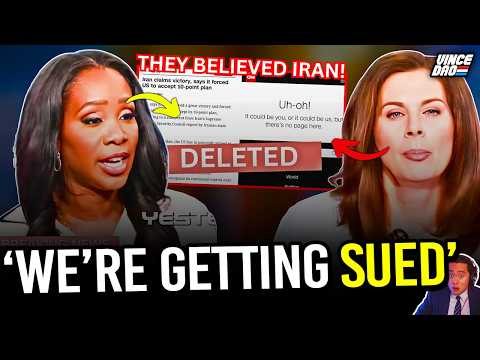
CNN published and later retracted a false story claiming the US accepted Iran's 10-point peace plan, based solely on Iranian state media sources. The US and Iran agreed only to a ceasefire and to negotiate further, contradicting CNN's initial report. This incident highlights media failures in verifying information and the ongoing politicization of Iran conflict coverage.
Recently, CNN faced significant backlash and humiliation after publishing a story claiming that the United States had accepted Iran's 10-point peace plan during ceasefire negotiations. This story was based solely on Iranian state media sources and a dubious news site from Nigeria. The network was forced to retract the story and delete the webpage after the inaccuracies were exposed.
Contrary to CNN's initial report, the only confirmed agreement between the US and Iran is that Iran will continue to control the Strait of Hormuz and allow ships to pass through under their control. The two sides agreed to a ceasefire for two weeks, allowing safe passage through the Strait coordinated with Iran's armed forces.
President Trump acknowledged accepting the framework of Iran's 10-point peace plan as a basis for negotiations, not an acceptance of all terms. This distinction is crucial: a framework or basis for negotiation means discussions will continue, not that the US has surrendered to Iran's demands.
CNN's report quoted Iranian state media claiming Iran had forced the US to accept its 10-point plan, including lifting all sanctions and withdrawing US forces from the region. These claims were unrealistic and contradicted official statements from both the US and Iran.
CNN admitted to sourcing the story from Iranian officials and multiple Iranian state media outlets but failed to independently verify the information. This lack of fact-checking led to the dissemination of false information.
President Trump responded by calling the CNN story a fraud, noting that the false statement was linked to a fake news site from Nigeria. The incident raised questions about CNN's journalistic integrity and their editorial standards.
Iran's Supreme National Security Council and Foreign Minister Aragoti clarified that the US had accepted the general framework of Iran's proposal as a basis for negotiations, not the full 10-point plan. They confirmed the ceasefire and the coordination for safe passage through the Strait of Hormuz but did not confirm any agreement on lifting sanctions or nuclear enrichment.
This official stance aligns with President Trump's statements and contradicts CNN's initial claims.
Brendan Carr, chairman of the FCC, condemned CNN's conduct, calling for accountability due to the sensitive nature of national security matters involved. He emphasized that spreading hoax headlines undermines trust and national security.
CNN's PR team attempted damage control by reiterating their reliance on Iranian officials and state media but eventually removed the false story and updated their coverage to reflect the ceasefire agreement only.
This incident is not isolated. Throughout the ongoing conflict, mainstream media outlets, including CNN, have repeatedly fallen for Iranian state propaganda, often to undermine former President Trump. They have portrayed conflicting narratives, sometimes accusing Trump of lying about negotiations and other times criticizing him for ceasefire agreements.
The media's inconsistent and often politically motivated coverage has led to public confusion and skepticism about the true state of affairs.
The CNN retraction highlights the dangers of uncritically accepting and reporting information from adversarial state media without independent verification. It underscores the importance of journalistic integrity, especially in matters of international conflict and national security.
As the ceasefire holds and negotiations continue, it is vital for media outlets to provide accurate, balanced, and verified reporting to inform the public responsibly.
The polarized media environment often leads to contradictory narratives depending on political leanings. This case exemplifies how misinformation can spread even among major news organizations, emphasizing the need for critical consumption of news and demand for higher journalistic standards.
Readers are encouraged to stay informed through multiple credible sources and remain vigilant about the accuracy of news related to international conflicts.
Let us know your thoughts on this incident and the broader media coverage of the Iran conflict in the comments section below. Your engagement helps promote informed discussions and accountability in journalism.



















