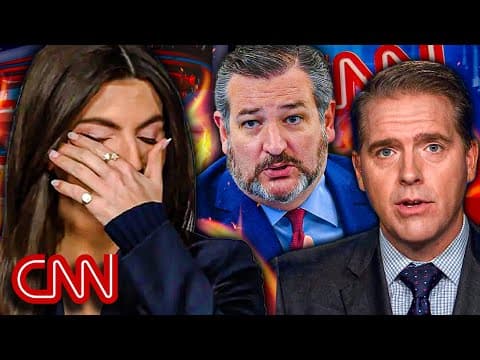
In a recent CNN segment, Scott Jennings and Senator Ted Cruz confronted the network's narrative on political violence, leading to a significant media meltdown. Jennings challenged the dismissal of social media reactions, while Cruz fact-checked claims about the motives behind a recent assassination. This confrontation highlights the ongoing struggle for credibility within legacy media.
What happens when CNN hosts get caught red-handed denying reality, while their own colleague explodes with righteous fury? The recent segment on CNN’s NewsNight showcased a moment that many are calling the left-wing media's worst day yet. This incident not only highlighted the ongoing credibility crisis within legacy media but also showcased the rising influence of conservative voices in the media landscape.
In a world where the legacy media is often criticized for its bias, CNN has found itself at the center of controversy once again. During a heated discussion, Scott Jennings, the lone conservative voice on the panel, posed a critical question that left his fellow panelists scrambling. His inquiry revolved around the disconnect between social media reactions and the reality of political violence in America.
Jennings initiated the confrontation by stating, "The Internet is not real life." He emphasized that while there are thousands of ordinary people celebrating political violence on social media, it is crucial to distinguish between these random individuals and the broader political landscape. He questioned whether it was appropriate to categorize half the country based on the actions of a few.
His fellow panelists struggled to respond, with one, Abby Philip, initially claiming that the scope of the issue was unclear. As the discussion progressed, Jennings pressed further, highlighting the dangers of dismissing the voices of those celebrating violence. He pointed out that political assassinations have occurred in the past, and there have always been individuals who cheered such acts.
The exchange escalated as Jennings accused Philip of gaslighting the audience. He noted how her responses shifted from uncertainty about the number of celebrators to questioning whether such reactions should be the focus of concern. Jennings argued that the real issue was not just the existence of these reactions but the normalization of violence against public figures, particularly those who are not politicians.
He posed a poignant question: "When was the last time someone like Charlie Kirk was gunned down and openly celebrated by professionals across various fields?" This rhetorical question aimed to highlight the moral implications of such celebrations and the need for a serious discussion about the underlying issues.
The media meltdown continued when Senator Ted Cruz appeared on CNN, where he confronted Caitlyn Collins over her assertion that the motive behind a recent assassination was still unknown. Cruz did not merely push back; he fact-checked her live on air, asserting that her statement was factually incorrect.
Cruz's intervention was significant as he laid out the facts surrounding the case, challenging the narrative being presented by Collins. His insistence on accuracy in reporting underscored the importance of accountability in journalism, especially in discussions surrounding sensitive topics like political violence.
This confrontation between Jennings and Cruz against the backdrop of CNN's narrative raises critical questions about the state of media credibility. As viewers witnessed the unraveling of a carefully constructed narrative, it became evident that the legacy media's grip on public perception is increasingly being challenged by conservative voices.
The incident serves as a reminder of the ongoing struggle for truth in journalism and the necessity for media outlets to uphold standards of accuracy and integrity. As the landscape of media continues to evolve, the demand for accountability and transparency will only grow.
In conclusion, the recent CNN segment featuring Scott Jennings and Senator Ted Cruz exemplifies the tensions within the media regarding political narratives and the portrayal of violence. As the legacy media grapples with its credibility crisis, the emergence of alternative voices is reshaping the conversation around these critical issues. The fallout from this confrontation may have lasting implications for how media outlets approach reporting on political violence and the reactions it elicits from the public.