
This blog post explores the complex interactions between European powers and indigenous populations during the age of colonization in the New World, focusing on the roles of Spain, France, the Netherlands, and England from 1492 to the 1700s. It discusses the motivations behind colonization, the impact of the Protestant Reformation, and the relationships formed with Native Americans, highlighting the contrasting approaches of different nations.
In the previous chapter, we examined Christopher Columbus's journey to the New World and the early Spanish colonization efforts. This chapter expands our focus to include other European nations involved in the colonization of the Americas, particularly Spain, Portugal, France, the Netherlands, and England, from approximately 1492 to the 1700s. This period is marked by competition among these nations and their interactions with indigenous populations.
The Spanish Empire, primarily centered in Central and South America, established its capital in Mexico City, built on the ruins of the Aztec capital, Tenochtitlan. Initially, Spanish colonization was driven by conquest and plunder, but it later evolved into more structured economic systems, such as the encomienda and hacienda systems.
While most of the Spanish Empire's activities were in South America, Spain also had a significant presence in North America. Notably, the oldest European structure in what is now the United States is Spanish, not English, indicating Spain's earlier involvement in the region. Two key areas of Spanish presence in North America were:
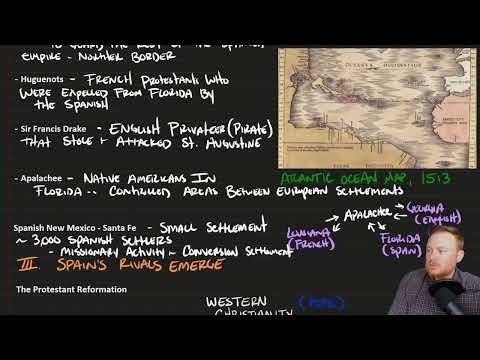
Spanish Florida: The settlement of St. Augustine served as a military outpost to protect Spanish interests. Spain expelled French Huguenots attempting to settle in Florida, demonstrating its intolerance for other European nations encroaching on its territory.
Santa Fe, New Mexico: This settlement was primarily a center for missionary activity aimed at converting the local Pueblo people to Catholicism. Unlike Florida, Santa Fe was not economically or militarily significant but played a crucial role in Spain's religious objectives.
The Protestant Reformation, which began in 1517, significantly altered the religious landscape of Europe, leading to a split between Protestant and Catholic nations. This division fueled conflicts that spilled over into the New World, as nations aligned themselves with either side. England and the Netherlands became predominantly Protestant, while Spain and France remained Catholic.
The rivalry between these nations was not only nationalistic but also deeply rooted in religious conflict. For instance, the Spanish expelled French Huguenots from Florida not only due to their nationality but also because of their Protestant faith. This religious strife contributed to the motivations for colonization, as nations sought to spread their respective faiths and gain converts.
The French, motivated by the search for the Northwest Passage to Asia, established a presence in North America, particularly in Eastern Canada and along the St. Lawrence and Mississippi Rivers. Samuel de Champlain, known as the father of New France, founded Quebec, which became the capital of the French colony.
French colonization was characterized by a focus on trade, particularly in furs, and a relatively cooperative relationship with Native Americans. French fur traders relied on Native American knowledge and cooperation for their success, while Jesuit missionaries sought to convert indigenous peoples through peaceful means, often learning their languages and cultures.
The Dutch, primarily motivated by profit, established New Netherland, with its capital at New Amsterdam (modern-day New York City). The Dutch East India Company became a powerful commercial entity, dominating trade in Asia and later taking over the Atlantic slave trade from the Portuguese.
Unlike the Spanish, the Dutch were less interested in conquest and more focused on trade. They acquired land through purchase rather than outright conquest, leading to a more complex relationship with Native Americans. The Dutch also introduced the patroon system, granting large tracts of land to settlers willing to move to the New World, although this system did not lead to significant population growth.
While the Portuguese did not establish a significant presence in North America, they claimed Brazil in South America through the Treaty of Tordesillas in 1494. This treaty divided the New World between Spain and Portugal, with Brazil falling under Portuguese control. The Portuguese introduced sugar plantations and African slavery to Brazil, which would become a dominant economic system in the region.
English colonization was driven by a combination of profit and religious motives. The Virginia Company, a joint-stock company, established Jamestown in 1607 as the first permanent English colony in the New World. The initial settlers faced numerous challenges, including starvation and disease, but the discovery of tobacco as a cash crop ultimately saved the colony.
The English approach to colonization was influenced by their experiences in Ireland, where they segregated themselves from the native population. This model carried over to the New World, leading to a lack of mixed-race populations compared to Spanish and French colonies.
In contrast to the profit-driven Southern colonies, the New England colonies were primarily founded for religious reasons. The Puritans sought to create a "city upon a hill," a model community based on their religious beliefs. This led to a more family-oriented demographic and a relatively egalitarian society compared to the class divisions in Virginia.
The Puritans established a strict religious community, often banishing dissenters like Anne Hutchinson and Roger Williams, who advocated for religious freedom. Over time, however, the rigid Puritanical laws began to relax, leading to a rise in religious pluralism.
The age of colonization in the New World was marked by complex interactions between European powers and indigenous populations. Each nation brought its own motivations, strategies, and cultural influences, shaping the development of the Americas. As these cultures collided, they laid the groundwork for the diverse and often tumultuous history that would follow in the centuries to come.



















