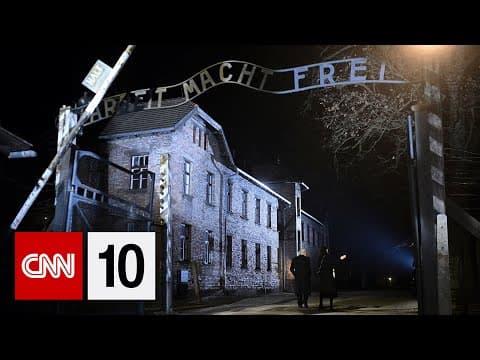
This blog post commemorates the 80th anniversary of the liberation of Auschwitz, highlighting survivor testimonies, global tributes, and the importance of educating future generations about the Holocaust.
This week marks a significant and solemn occasion as we observe the 80th anniversary of the liberation of the Auschwitz Concentration Camp in Poland. This event serves as a poignant reminder of the atrocities committed during World War II and the resilience of those who survived.
Survivors of Auschwitz were invited to participate in the commemorative events, which honored their experiences at one of the deadliest Nazi concentration camps. The ceremonies included speeches from survivors, prayers, and tributes to the victims who lost their lives in the camp. Polish President Andrzej Duda and Auschwitz Museum Director Piotr Cywiński led survivors in a solemn procession, carrying candles to the Camp's Wall of Death, a site where many executions took place.
World leaders also paid their respects. German Chancellor Olaf Scholz and President Frank-Walter Steinmeier, along with French President Emmanuel Macron, who participated from the Shoah Holocaust Memorial in Paris, highlighted the global significance of this anniversary. British King Charles laid a wreath at the Wall of Death, joined by royalty from Norway, Spain, and Denmark, all honoring the memory of the victims.
Between 1940 and 1945, approximately 1.1 million people were murdered at Auschwitz, with the majority being Jewish. Other victims included Polish resistance fighters, Roma, and Soviet prisoners of war. When the camp was liberated, around 7,000 individuals, many gravely ill or near death, were freed from Nazi imprisonment. The day's ceremonies focused on the survivors present, as many of them are now in their 80s. According to the Claims Conference, an advocacy group for survivors, only about 1,000 of these individuals are still alive today.
In 2005, the United Nations designated January 27th as International Holocaust Memorial Day, a day of remembrance for the six million Jews who perished during the Holocaust, representing two-thirds of Europe's Jewish population and one-third of the global Jewish community.
One of the survivors, Jackie Young, has dedicated the last 13 years to educating teenagers about the Holocaust by sharing his personal story. As a baby, he was sent to a Nazi concentration camp and survived for two years and eight months. Jackie arrived in the UK in 1945 on a British Royal Air Force plane, but his adoptive parents never revealed his past as a Holocaust survivor.
Jackie reflects on his journey of discovery, stating, "Any little piece of the puzzle of my past would be more than welcome." Despite the challenges of piecing together his early life, he finds clarity and purpose in sharing his experiences with younger generations. He emphasizes the importance of education in combating prejudice and promoting peace, stating, "It reminds us of the importance of teaching and educating younger generations."
As the years pass, there is a growing concern that the current generation may be the last to hear firsthand accounts from Holocaust survivors. Jackie’s story serves as a vital lesson in humanity, urging the younger generation to understand the consequences of hatred and intolerance. He hopes that by sharing his experiences, he can open the eyes of young people to the realities of history and the importance of remembrance.
The 80th anniversary of the liberation of Auschwitz is not just a commemoration of the past; it is a call to action for future generations. As we reflect on the horrors of the Holocaust, we must also commit to educating ourselves and others to ensure that such atrocities are never repeated. The stories of survivors like Jackie Young are crucial in keeping the memory of those who suffered alive, reminding us of the resilience of the human spirit in the face of unimaginable adversity.