
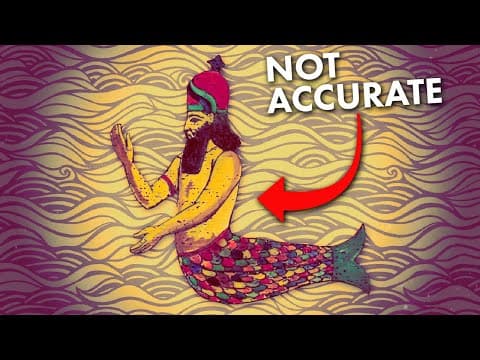
This blog post explores the misconceptions surrounding Dagon, the Philistine deity often mischaracterized as a fish-god. It delves into the archaeological evidence of Philistine culture, their pantheon of gods, and the historical context that shaped the narratives found in the Hebrew Bible.
The story of Dagon, the Philistine deity, is often misunderstood. Many people associate him with fish imagery, believing him to be a fish-god or a merman. This misconception has roots in interpretations from the 1800s and early 1900s, which have permeated biblical literature and popular culture. However, a closer examination of archaeological evidence and historical context reveals a more complex picture of Dagon and the Philistines.
The narrative surrounding Dagon is prominently featured in the Hebrew Bible, specifically in 1 Samuel chapter 5. In this account, the Philistines capture the Ark of the Covenant, a sacred object for the Israelites, and place it in the temple of Dagon in Ashdod. The next day, they find the statue of Dagon toppled before the Ark, and after resetting it, they discover it again lying on the ground, this time decapitated. This story illustrates the power of the Israelite God over foreign deities, but it raises questions about the identity of Dagon.
Traditionally, Dagon has been described as the national god of the Philistines, often depicted with fish-like features. However, this characterization is misleading. The name "Dagon" has been linked to the Hebrew word for fish, "dag," leading to the erroneous belief that he was a fish-god. This interpretation lacks substantial evidence and is largely based on post-biblical commentary rather than archaeological findings.
To understand Dagon's true nature, we must explore the archaeology of the Philistines. The Philistines were an ancient people who settled along the southeastern coastal plain of the Mediterranean around the 12th century B.C. They are believed to have descended from the Sea Peoples, a confederation of tribes from various Mediterranean regions. Known for their advanced metalworking and military prowess, the Philistines also had distinct cultural practices, including their religious beliefs.
Philistine religion was a blend of deities from their Aegean origins and new gods encountered in the Eastern Mediterranean. Evidence from inscriptions and figurines suggests that they worshipped a variety of gods and goddesses, including a mysterious goddess referred to as "ptg YH" and possibly the Canaanite goddess Astarte. The absence of Dagon in archaeological records raises doubts about his status as a major deity among the Philistines.
While Dagon is not well-documented in Philistine sites, he was a significant figure in the ancient Near East, particularly in the Middle Euphrates region. Historical texts describe him as a high god associated with creation and the ruler of the valley. His worship was concentrated in cities like Terqa and Tutul, where temples served as both religious and administrative centers.
Despite the biblical claims, there is no archaeological evidence to support the idea that the Philistines worshipped Dagon. Scholars argue that the biblical texts linking Dagon to the Philistines were written centuries after the events they describe, leading to potential inaccuracies in the portrayal of Philistine culture. The strongest evidence suggests that Philistine religion was more focused on goddesses rather than a male deity like Dagon.
The notion of Dagon as a fish-god can be traced back to early Christian and Jewish commentators, particularly Jerome, who made a derogatory connection between Dagon's name and the Hebrew word for fish. This idea was later popularized by medieval scholars and has persisted in modern interpretations. However, there is no evidence to support the idea that Dagon had any fish-like characteristics.
Some scholars propose that Dagon's name may derive from a Semitic root related to grain, suggesting he could have been associated with agriculture rather than aquatic themes. This interpretation is supported by limited ancient texts that refer to him as a lord of seeds, although such references are scarce.
The story of Dagon serves as a reminder of the complexities of historical and archaeological narratives. While the Hebrew Bible presents Dagon as a chief deity of the Philistines, archaeological evidence indicates that his worship was primarily centered in the Euphrates Valley, with the Philistines likely focusing on a pantheon that included various goddesses. The enduring myth of Dagon as a fish-god is a product of later interpretations rather than historical fact. Understanding these nuances allows us to appreciate the rich tapestry of ancient cultures and their beliefs.



















