
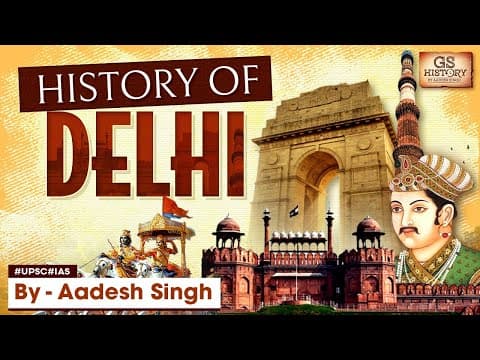
Delhi has served as a significant political center and capital for various empires throughout its history, showcasing a rich tapestry of cultural and architectural heritage from ancient times to the present.
Delhi, the capital of India, is not just a political hub but a city steeped in history, having served as the capital for numerous empires over thousands of years. Situated on the banks of the Yamuna River, Delhi has played a pivotal role in shaping Indian civilization, much like Rome did for the Roman Empire. Jawaharlal Nehru, India's first Prime Minister, referred to Delhi as a nursery of empires and a republic, symbolizing the glory and disasters of various dynasties.
An ancient saying goes, "He who rules Delhi, rules India," indicating the city's significance in the political landscape of the country. The earliest references to settlements in Delhi can be traced back to the Mahabharata, where the capital of the Pandavas, Indraprastha, is believed to be located in present-day Delhi. From Indraprastha to New Delhi, the city has witnessed the rise and fall of numerous dynasties.
Historians identify seven cities within Delhi, each representing different dynasties, and when including New Delhi, the total rises to eight. This blog post will take you through the journey of these seven cities.
The history of Delhi as a fortified city began in 1060 AD when Anangpal Tomar shifted his capital to Lal Kot. This marked the beginning of fortifications in Delhi. The Tomar dynasty, initially a vassal of the Gurjara-Pratihara Empire, established Lal Kot as a sovereign principality after the decline of the Pratihara Empire. In 1179, Prithviraj Chauhan ascended the throne, expanding Lal Kot, which later became known as Qila Rai Pithora, named after him. During this period, 27 Hindu temples were constructed in the area, showcasing the architectural prowess of the time.
In 1192, Muhammad of Ghor defeated Prithviraj Chauhan, marking the end of the Chauhan dynasty. Following Ghor's death in 1206, Qutb al-Din Aibak established the Slave Dynasty, initiating the Islamic rule in Delhi. In 1290, Jalal-ud-din Khilji founded the Siri Fort to defend against Mongol invasions, making it the second city of Delhi. This fort was strategically located northeast of the Qutub Minar.
The Tughlaq dynasty began in 1320 when Ghiyas-ud-din Tughlaq established Tughlaqabad as the third city of Delhi. The construction of Tughlaqabad Fort was ambitious, but it was abandoned shortly after due to various challenges. The fort's ruins still stand today, a testament to the architectural endeavors of the Tughlaq dynasty.
Mohammad bin Tughlaq, who succeeded his father, established Jahanpanah between 1326 and 1327 as a refuge for his subjects. This city absorbed the remnants of the earlier cities, including Qila Rai Pithora and Siri. The fortifications of Jahanpanah can still be seen in areas like IIT Delhi and Khidki Masjid.
Firoz Shah Tughlaq, a more stable ruler compared to his cousin, constructed Firozabad in 1354. This city is known for its rich heritage, including the famous Jami Masjid, which impressed Timur during his invasion. The city also features several historical structures, including the 64-column mosque and the Begumpur Mosque.
After the defeat of Humayun by Sher Shah Suri in 1540, Shergarh was established, which is now known as Purana Qila. This fort is believed to be built on the ruins of ancient Indraprastha. Sher Shah introduced new architectural styles, and the fort remains one of the oldest in India.
Shah Jahan established Shahjahanabad in 1648, which served as the Mughal capital until the empire's decline in 1857. The city is renowned for its magnificent structures, including the Red Fort and Chandni Chowk. Shahjahanabad exemplifies secularism, housing various religious sites, including temples and mosques.
Delhi's history is a rich tapestry woven with the threads of various empires, invasions, and cultural exchanges. From the ancient times of the Mahabharata to the modern era, Delhi has witnessed the rise and fall of numerous rulers and dynasties. Despite the challenges, including invasions and destruction, Delhi has maintained its identity as a vibrant city, symbolizing India's rich past and dynamic present. Today, it stands as a testament to the resilience and diversity of Indian civilization, where ancient history coexists with modernity.



















