
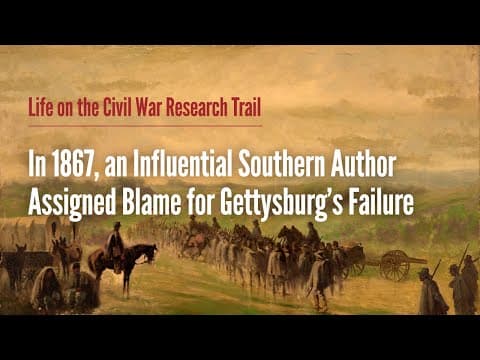
In his 1867 book, Edward Alfred Pard critiques the Confederate leadership during the Battle of Gettysburg, attributing the loss to General Lee's hesitation rather than a lack of valor among the troops. Pard's narrative emphasizes the importance of decisive action and the consequences of inaction, particularly on the first day of battle, which allowed Union forces to fortify their positions.
In the aftermath of the Civil War, many narratives emerged to explain the conflict and its outcomes. One of the most influential voices was Edward Alfred Pard, a Virginia journalist and newspaper editor. His 1867 book, The Lost Cause: A New Southern History of the War of the Confederates, sought to codify the Lost Cause narrative, which framed the Southern experience in a particular light. This blog post explores Pard's analysis of the Battle of Gettysburg, focusing on his critique of Confederate General Robert E. Lee's leadership.
Pard wrote during a time when the memories of the Civil War were still fresh, and many official records had yet to be published. His insights were likely drawn from newspaper reports, interviews with veterans, and other contemporary accounts. Pard aimed to establish a narrative for posterity, highlighting both the heroes and the failures of the battle.
The Battle of Gettysburg, fought from July 1 to July 3, 1863, was a pivotal moment in the Civil War. It marked a turning point for the Union forces, who successfully repelled the Confederate invasion of the North. Pard's account begins with the initial clash on July 1, where Confederate forces initially gained the upper hand.
Pard describes how the Confederate forces, led by General Heath, met the advancing Union troops and achieved early success. The Union line was broken, and the streets of Gettysburg were filled with fleeing soldiers. However, this initial victory was not capitalized upon. Pard criticizes Lee's decision to halt the advance, allowing Union General Meade to fortify Cemetery Ridge, which would become a critical defensive position.
Pard emphasizes that Lee's failure to pursue the routed Union forces on the first day was a decisive mistake. By not pressing the advantage, Lee allowed the Union army to regroup and strengthen their defenses. Pard argues that this single act of hesitation turned the tide of the battle, enabling the Union to occupy a nearly impregnable position.
On July 2, the battle continued with fierce fighting. Pard notes that while the Confederates made some gains, particularly on the left flank, the attacks were disjointed and lacked the coordination necessary for a decisive victory. He attributes these failures to the circumstances on the ground rather than a lack of valor among the Confederate troops.
Pard recounts the intense fighting that took place as Longstreet's forces attacked the Union left. Despite initial successes, the Confederate troops faced fierce resistance and were ultimately unable to secure the heights. Pard highlights the bravery of the soldiers but suggests that the lack of a cohesive strategy contributed to their inability to capitalize on their early advantages.
The climax of the battle occurred on July 3 with Pickett's Charge, a bold but ultimately disastrous assault on the center of the Union line. Pard vividly describes the scene as Confederate troops advanced across open ground under heavy fire. Despite their bravery, the charge resulted in catastrophic losses for the Confederates.
Pard notes that the charge was marked by extraordinary acts of valor, but it was also a moment of profound tragedy. Many of the Confederate leaders were killed or wounded, and the division suffered heavy casualties. Lee's reaction to the failure of the charge was one of quiet resolve, as he rallied his troops and acknowledged the day's losses without dramatic displays of emotion.
Pard's account of the Battle of Gettysburg serves as a critical reflection on the Confederate leadership and the factors that contributed to their defeat. He attributes the loss not to a lack of courage among the soldiers but to General Lee's hesitation and failure to capitalize on early successes. This narrative has influenced how the battle is remembered and has contributed to the broader Lost Cause ideology.
In summary, Pard's analysis provides valuable insights into the complexities of the Battle of Gettysburg and the challenges faced by the Confederate army. His work remains a significant contribution to Civil War historiography, shaping the understanding of this pivotal conflict for future generations.



















