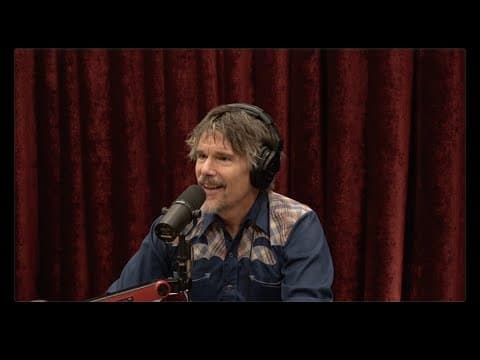
In a candid conversation on the Joe Rogan Experience, Ethan Hawke reflects on his journey from child actor to seasoned performer, the challenges of fame, the art of acting, and the importance of humility and presence. He discusses his early experiences, the impact of social media, the value of a beginner's mindset, and the profound moments that shape his craft and life philosophy.
In a wide-ranging and candid conversation on the Joe Rogan Experience podcast, acclaimed actor Ethan Hawke opens up about his journey in the entertainment industry, the challenges of childhood fame, the craft of acting, and his personal philosophies on life and creativity. This article distills the key moments and reflections from their engaging discussion.
Ethan Hawke began acting at the age of 12, initially enrolled in acting classes by his mother to keep him occupied during the winter months. His first role was in a local theater production of George Bernard Shaw's St. Joan in New Jersey, where he played a knight with one line. This experience was eye-opening for him, as he witnessed actors deeply engaged in their craft and realized that acting could be a viable career.
His first major film role came at age 14 in a $30 million movie directed by Joe Dante, where he worked alongside River Phoenix. Despite the excitement, the film was a commercial failure, which led Hawke to temporarily put aside his acting ambitions and return to high school.
After graduating high school and attending college, Hawke auditioned for Dead Poets Society and landed a role. The success of this film marked a turning point, reigniting his passion for acting. He credits the film's director, Peter Weir, and co-star Robin Williams for creating an environment that treated acting as a serious art form and a mission beyond mere success or failure.
Hawke discusses the difficulties many child actors face, noting that early fame can impede normal development. He emphasizes the importance of experiencing life outside of the spotlight to build resilience and a balanced perspective. His own gradual introduction to fame allowed him to develop a resistance to its potentially toxic effects.
Hawke shares touching stories about his mother, who overcame personal challenges and dedicated much of her life to humanitarian work in Romania. He also highlights the influence of his father, who valued integrity over fame or money, providing a grounding force throughout his career.
Mentorship and learning from seasoned actors like Vanessa Redgrave and Philip Seymour Hoffman have been instrumental in his growth. He admires their humility, dedication, and mastery of the craft.
Acting, according to Hawke, is about becoming another person and fully inhabiting their perspective without judgment. He likens great acting to hypnosis, where the audience is drawn into the character's reality, forgetting the actor behind the role.
He stresses the importance of presence, listening, and being fully engaged with scene partners. Bad acting, he explains, often feels self-conscious or glib, breaking the immersive experience.
Improvisation is a key tool, but it requires months of preparation and deep understanding of the character and story.
Hawke candidly discusses the impact of criticism, especially in the age of social media. He warns against the dangers of reading negative comments, which can be demoralizing and distracting. Instead, he advocates for developing a thick skin and recognizing that much of the negativity reflects the insecurities of the critics themselves.
Regarding social media, Hawke does not impose strict restrictions on his children but encourages open discussions about its effects. He acknowledges its addictive nature and the challenges it poses to concentration and mental health.
A recurring theme in the conversation is the value of humility and the willingness to admit "I don't know." Hawke recalls advice from a director early in his career emphasizing that admitting ignorance is essential for learning and growth.
He encourages embracing new challenges outside one's comfort zone, such as learning a new language or instrument, to keep the mind flexible and open.
Hawke reflects on the balance between professional ambition and personal fulfillment. He values making meaningful art over chasing fame or money and finds joy in the creative process itself.
He admires actors like Jeff Bridges and Paul Scofield, who have sustained long, fulfilling careers grounded in love for their craft rather than external validation.
Drawing parallels between acting, music, and sports, Hawke describes the state of being fully immersed in a performance as a form of hypnosis. This state allows actors to disappear into their roles, creating a shared imaginative experience with the audience.
He recounts working with Denzel Washington on Training Day, where much of the dialogue was improvised, showcasing Washington's extraordinary presence and creativity.
Hawke shares memorable anecdotes, such as working with a wolf on the set of White Fang, which taught him about presence and authenticity.
He also discusses the importance of fear and nervousness in performance, citing Mike Tyson's mindset before fights as an example of how anxiety can be a powerful motivator rather than a hindrance.
The conversation touches on broader themes of human potential, the significance of art, and the experience of awe when observing the cosmos. Hawke emphasizes that creativity is a fundamental human expression that connects us to something larger than ourselves.
He encourages embracing the journey of continuous learning and growth, maintaining a balance between dedication to craft and openness to new experiences.
Ethan Hawke's conversation with Joe Rogan offers a profound look into the life of an artist committed to his craft and personal growth. His insights on acting, fame, resilience, and creativity provide valuable lessons for aspiring actors and anyone seeking to live a meaningful and authentic life.
This interview is a testament to the power of humility, presence, and the relentless pursuit of excellence in the face of life's challenges.