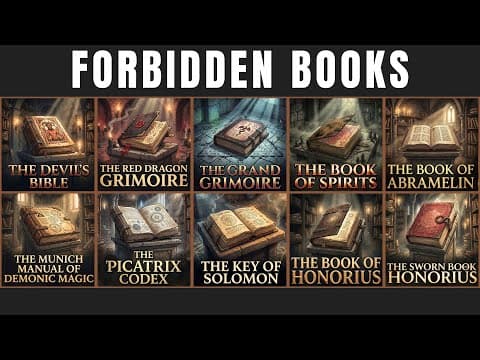
This article delves into the histories and contents of 10 dark and dangerous books that were once banned. From the cursed Devil's Bible to grimoires promising infernal power, these manuscripts contain forbidden knowledge, occult rituals, and eerie legends that have haunted readers and authorities for centuries.
Throughout history, certain books have been banned, not merely for controversial ideas, but for the dangerous and dark knowledge they purportedly contain. These manuscripts, often shrouded in mystery and legend, have fascinated and terrified readers alike. This article explores ten such books, their origins, contents, and the chilling stories surrounding them.
In 1648, during the Thirty Years War, Swedish forces seized numerous artifacts from the Benedictine monastery of Broumov, including an enormous manuscript weighing over 165 pounds. This manuscript, bound in leather and reinforced with wooden and iron, required two men to lift it. It later became known as the most cursed book ever written: The Codex Gigas, or The Devil’s Bible.
According to monastery records, the Codex was created in the early 13th century by a monk named Herman the Recluse. Facing death for breaking monastic vows, Herman begged for a chance to atone by creating the largest book ever written to glorify God. He was granted a single night, and by morning, the book was inexplicably complete. The manuscript contains 624 pages, all written in the same flawless script without corrections or hesitation marks. Scholars estimate that producing it by hand would have taken at least 20 years.
Legend suggests Herman made a pact with the devil to complete this feat.
The book contains the complete Vulgate Bible, texts on exorcism, medicine, astronomy, and a collection of magical formulas. However, more disturbing are the pages in between, which include:
One notable page features a full-body portrait of Satan, horned and crouching, staring directly at the reader with an unnerving calm. This image has haunted those who have gazed upon it for centuries.
Some pages appear scorched, as if someone attempted to destroy specific knowledge but stopped short. The ink contains traces of arsenic, mercury, and bone ash.
After its seizure, the Codex was stored in the Royal Library of Stockholm, where it remains today. However, several pages are missing, officially explained as damage during relocation. Rumors suggest these lost sections contained diagrams of infernal geometry and invocations requiring vocal harmonics to activate.
A 1973 restricted report from the Swedish National Heritage Board tells of a librarian hospitalized after attempting to read the entire book in one night. He claimed to hear whispers between the words and began speaking in an unknown language. The case was quietly suppressed.
The Codex Gigas is now kept in a climate-controlled glass vault with restricted access. The Vatican has requested to examine it but has been denied without comment.
In 1521, a manuscript was discovered hidden in the catacombs beneath the Bastille, wrapped in cloth soaked with myrrh and sealed with red wax. The guards who found it delivered it to an inquisitor, who vanished days later, with the book missing from his quarters.
Known as Le Dragon Rouge, the Red Dragon, this grimoire is a step-by-step guide for making a pact with infernal forces in exchange for earthly power. It claims authorship by Alibeck the Egyptian, drawing upon forbidden knowledge from ancient Memphis.
The book opens with an invocation to Lucifer, asking for dominion over spirits commanding material wealth. It details rituals involving carving sigils into the skin with a blade dipped in goat’s blood and myrrh, reciting Latin passages to align the soul with a spirit of dominion.
The Red Dragon outlines methods to call upon a nameless intermediary who trades clarity for loyalty. These rituals are not referenced in any known occult manuscript.
The book has been lost and found across centuries, often appearing in black markets. Its dangerous nature is underscored by the disappearance of those who come into contact with it.
Emerging in the early 1750s among black market dealers, the Grand Grimoire claims to be the source text for many other grimoires. It allegedly originated from a mysterious cult in French Louisiana, possibly smuggled from the Papal Archives.
The Grand Grimoire promises the power to command celestial beings, including Lucifer, as servants. It describes hell’s hierarchy and demands utter fealty from the user.
Unlike other grimoires that seek knowledge, this book instructs the user to bind spirits through sigils and command them to answer questions about treasures, weather control, and the fate of souls.
The book details elaborate rituals requiring days of maintaining a salt circle, burning black dove feathers, and offering a biscuit soaked in human blood to Lucifer. The summoner must use a black wand and maintain solemnity to bind Lucifer to their will.
The Grand Grimoire is often paired with the Grimorium Verum, which outlines the demonic court’s structure and provides incantations and rites.
In 1407, a monk at Mont Saint-Michel Abbey vanished, leaving behind a soot-blackened codex titled Livre des Esprits, or The Book of Spirits.
Written in medieval Occitan, the book lists forty-six entities the Church refused to acknowledge, along with methods to summon them through blood rituals.
Unlike angels, demons, or elementals, these entities are described as "des esprits" or "the absent ones," with their nature left unexplained.
The Catholic Church banned the book, accusing its author of consorting with demons. Possession was considered dangerous, and many were executed for it.
Unlike other grimoires, The Book of Spirits is intended for self-exploration rather than power. Its incantations are keys to open the mind to other planes of existence.
The book warns of dangers such as hallucinations, uncontrollable tremors, and disgust toward the world, indicating when one has gone too far.
Discovered in 1990 at the Bavarian State Library, this 15th-century manuscript, Cod. Lat. 849, contains Latin incantations, sigils, and ritual diagrams.
Known as Liber Incantationum, Exorcismorum et Fascinationum Variarum, or The Munich Manual of Demonic Magic, it is believed to have been written around 1500 by an anonymous cleric knowledgeable in Catholic rites and esoteric heresies.
The manual compiles demonic invocation rituals, blending orthodox and heretical knowledge.
Several other infamous occult texts have been mentioned but not described in detail:
These grimoires also contain forbidden knowledge and rituals that have contributed to their controversial reputations.
The dark books explored here reveal a fascinating intersection of history, legend, and occult knowledge. Their contents range from religious texts to grimoires promising infernal power, often accompanied by warnings and tales of misfortune for those who dare to read them.
Whether viewed as historical artifacts, literary curiosities, or sources of supernatural dread, these banned books continue to captivate and caution readers worldwide.