
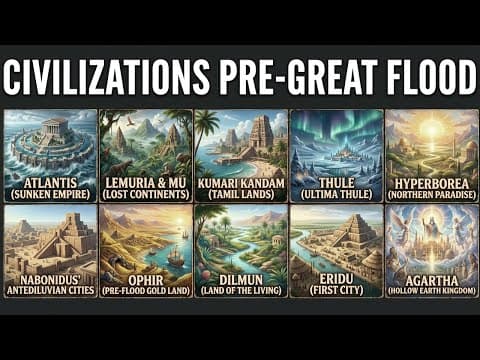
This article delves into ancient lost civilizations predating the Great Flood, focusing on remarkable archaeological sites like Gobekli Tepe in Turkey and the Yonaguni Monument in Japan. These sites challenge conventional history with their advanced construction, astronomical knowledge, and mysterious purposes, suggesting sophisticated societies existed far earlier than previously believed, raising profound questions about human origins and civilization development.
Human history is often told as a linear progression from primitive hunter-gatherers to complex civilizations. However, recent archaeological discoveries challenge this narrative, revealing lost civilizations that existed long before the Great Flood and the rise of known ancient empires. This article explores some of these enigmatic cultures, focusing on two of the most compelling sites: Gobekli Tepe in Turkey and the Yonaguni Monument in Japan.
Imagine standing on a hill in Southeastern Turkey around 9,600 BCE. Below, hundreds of people are hauling massive limestone pillars weighing between ten to twenty tons. They do this without the aid of wheels, metal tools, or pack animals. They are building a temple — but according to traditional history, such a society should not exist yet. At this time, humans were believed to be nomadic hunter-gatherers, too primitive for organized religion or monumental architecture.
In 1994, German archaeologist Klaus Schmidt began excavations at Gobekli Tepe, a site long avoided by local shepherds who believed it was cursed. What Schmidt uncovered forced a complete revision of the Neolithic Revolution timeline. Radiocarbon dating places the construction of Gobekli Tepe between 9600 and 8200 BCE, making it approximately 11,600 years old. This predates Stonehenge by 6,000 years and the Egyptian pyramids by 7,000 years.
Gobekli Tepe covers 22 acres and contains at least 20 stone circles identified through ground-penetrating radar. The limestone pillars are T-shaped, reaching up to 18 feet tall and weighing as much as 20 tons each. These pillars are intricately carved with over 200 animal reliefs, including foxes, lions, scorpions, vultures, and serpents, all crafted with surgical precision.
What makes Gobekli Tepe particularly puzzling is the absence of evidence for habitation. There are no cooking fires, trash heaps, or dwellings. It appears to be purely ceremonial — a temple built by people who supposedly had not yet invented civilization.
Schmidt’s analysis suggests that a workforce of over 500 people labored over decades to build the site, indicating a level of social organization far beyond what nomadic bands should possess. One notable feature, Pillar 43 in Enclosure D, known as the Vulture Stone, has been interpreted by Martin Sweatman from the University of Edinburgh as possibly depicting a comet strike around 10,950 BCE.
The astronomical alignments of the site are deliberate, showing that these ancient builders had sophisticated knowledge of the sky.
The standard archaeological explanation suggests Gobekli Tepe represents a transitional moment when hunter-gatherers began gathering for ritual purposes, which eventually led to agriculture and settlement. This theory posits that the need to feed large ritual gatherings may have sparked the agricultural revolution, reversing the traditional cause-and-effect relationship.
Religion, therefore, came before farming, cities, and civilization itself.
Despite this explanation, many questions remain unanswered. If people did not settle down until after building Gobekli Tepe, where did they come from? How did scattered bands coordinate such precise astronomical alignments and artistic consistency across generations?
The pillars show no signs of gradual evolution from crude to refined craftsmanship; they appear fully formed, as if the knowledge was inherited rather than invented.
Around 8,000 BCE, the entire complex was deliberately backfilled with thousands of tons of sediment. This purposeful burial raises questions: Were the survivors trying to preserve something or hide it?
Some researchers speculate that Gobekli Tepe could be a remnant of an earlier, more sophisticated culture wiped out during the Younger Dryas climate catastrophe around 10,800 BCE. The precision, scale, and astronomical knowledge suggest inheritance rather than invention, hinting that this site might not mark the beginning of civilization but rather the echo of its end.
From the buried temples of Turkey, we move beneath the waves to Japan. In 1987, Kihachiro Aratake, a local dive tour operator, was searching for hammerhead sharks off the coast of Yonaguni Island. Instead, he discovered something extraordinary 100 feet beneath the Pacific Ocean: massive stone terraces with perfectly straight edges and what appeared to be staircases carved into the seabed.
The Yonaguni Monument stretches over 500 feet long and rises 90 feet from the ocean floor. The stone blocks weigh up to 1,000 tons and are arranged in terraced levels. Marine geologist Masaki Kimura from the University of the Ryukyus spent over 15 years diving and documenting the site.
Kimura identified quarry marks, tool marks, and post-holes suggesting human modification, fueling debate about whether the monument is a natural formation or the remains of an ancient civilization.
The Yonaguni Monument remains controversial. Some scientists argue it is a natural geological formation shaped by tectonic activity and erosion. Others believe it is evidence of a lost civilization submerged by rising sea levels after the last Ice Age.
If human-made, the monument would represent an advanced prehistoric culture with sophisticated engineering skills, challenging current understanding of ancient human capabilities.
The discoveries at Gobekli Tepe and the Yonaguni Monument compel us to rethink the origins of civilization. These sites suggest that advanced societies with complex social structures, religious practices, and astronomical knowledge existed far earlier than previously believed.
They raise profound questions about human history, the impact of climate catastrophes, and the possibility of lost civilizations that have been buried or submerged over millennia.
As archaeology and science continue to uncover these ancient mysteries, our understanding of humanity’s past will undoubtedly evolve, revealing a richer and more complex story than ever imagined.



















