
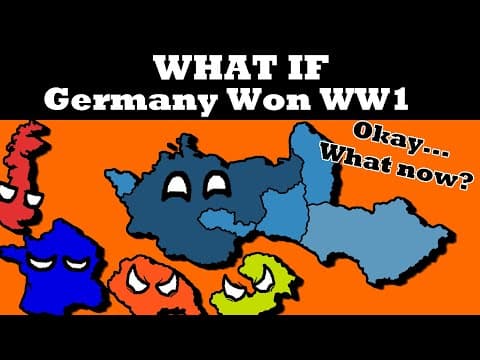
This blog post delves into the hypothetical scenario where the Central Powers won World War I, examining the geopolitical landscape of Europe and beyond in the aftermath. It discusses the fates of Russia, France, Austria-Hungary, and the Ottoman Empire, highlighting the internal strife, territorial changes, and the rise of new powers, ultimately leading to a transformed global order.
In this blog post, we will explore the alternate history of Europe and the world following a hypothetical victory of the Central Powers in World War I. This analysis will focus on the immediate aftermath of the war, the geopolitical landscape, and the internal struggles faced by various nations.
Following the Central Powers' victory, Germany emerged as a dominant force in Europe, having secured a buffer against Russia and annexed significant territories from France. Meanwhile, Britain retreated into self-isolation, and Russia found itself grappling with internal chaos and revolutionary movements.
Post-war Russia faced dire circumstances. The army had been demobilized, leaving many armed young men returning to farms owned by the nobility. The provisional government struggled with leadership and control, while revolutionaries demanded radical reforms. Ethnic minorities within the empire began to rise up for independence, further complicating the situation.
By 1920, Russia's borders had shrunk significantly, and the internal political landscape was fraught with challenges. The capital, St. Petersburg, was under the control of local Soviets, with various political factions vying for power. The government faced crippling debt from war reparations to Germany and loans from the Allies, alongside the pressing issue of land redistribution.
France, while better off than Russia, was still in a precarious situation. Germany had stripped away vital territories, including regions crucial for iron supply. France's diplomatic outlook was grim, surrounded by hostile powers like Germany and Italy, with its only potential ally, Russia, weakened.
Internally, France remained wealthy but faced the risk of radicalization. If France turned communist, it would likely provoke German intervention, leading to a restoration of the previous regime. Over time, France might integrate into the new German-dominated world order due to a lack of viable options.
Austria-Hungary emerged from the war as a deeply unstable entity. The dual monarchy faced significant challenges due to its diverse population, with Hungarians, Germans, and various Slavic groups all vying for power. The proposed reforms to create a Southern Slavic crown only exacerbated tensions, as different ethnic groups sought greater autonomy.
The Habsburg Empire's internal divisions made it increasingly difficult to maintain control. Economic pressures and rising nationalism among various groups led to a series of revolts, culminating in a crisis by the early 1930s. The empire's collapse seemed inevitable as revolts spread, and external pressures from Italy and Romania intensified.
The Ottoman Empire faced its own set of challenges post-war. The government initiated policies of ethnic cleansing against Armenians and other minorities, aiming to solidify Turkish dominance in Anatolia. However, the ruling elite, known as the "Three Pashas," became increasingly unpopular, leading to their eventual removal from power.
As the empire struggled to modernize and unify under a secular Turkish identity, it became a pawn in the power struggles between Britain and Germany. Massive investments flowed into the Ottoman Empire, but instead of becoming a superpower, it risked becoming a vassal state, losing its autonomy in the process.
With the Central Powers victorious, the global balance of power shifted dramatically. Germany emerged as a superpower, while the United States maintained its isolationist stance, focusing on its own interests in the Americas. Japan sought to expand its influence in China, leading to further conflict in the region.
As the world approached the 1940s, research into nuclear technology accelerated, with Germany becoming the first nation to develop nuclear weapons. This technological advancement created a new era of mutually assured destruction, fundamentally altering international relations and deterring aggressive actions against Germany.
The hypothetical scenario of a Central Powers victory in World War I presents a complex and tumultuous world. The geopolitical landscape of Europe and beyond would be drastically different, with nations grappling with internal strife, territorial disputes, and the looming threat of nuclear warfare. This exploration highlights the fragility of power dynamics and the profound impact of historical events on the course of nations.



















