
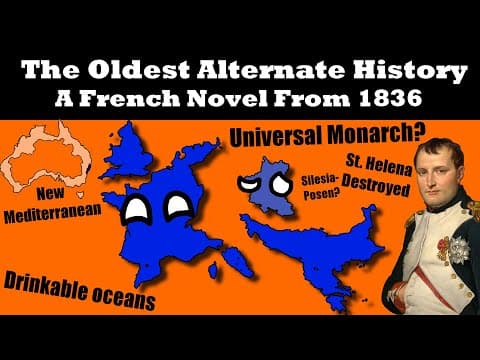
This blog post delves into Louis Napoleon Joffroy's 1836 alternate history novel, 'Napoleon and the Conquest of the World,' which imagines a victorious Napoleon reshaping Europe and beyond. It examines Joffroy's motivations, the portrayal of Napoleon's achievements, and the socio-political implications of this fantastical narrative, reflecting the romantic sentiments of post-Napoleonic France.
Napoleon Bonaparte's entry into Moscow marked a significant moment in his European campaigns, but it was far from the end of his ambitions. In this blog post, we will explore the fascinating alternate history presented in Louis Napoleon Joffroy's novel, "Napoleon and the Conquest of the World," published in 1836. This work imagines a world where Napoleon emerges victorious, reshaping Europe and beyond in a narrative that blends historical events with fantasy.
Joffroy wrote his novel just eleven years after Napoleon's defeat, during a time when France was grappling with political instability. The reinstated monarchs struggled to restore absolutism, leading to a revolution in 1830. Amidst this turmoil, many French citizens longed for the glory days of Napoleon, a sentiment that Joffroy captures in his writing. His personal connection to Napoleon, as his father had fought for the emperor, further fueled his admiration and shaped his narrative.
The novel begins with Napoleon's swift abandonment of Moscow, following its sabotage and subsequent flames. He sets his sights on St. Petersburg, the true capital of Russia, leading to the Tsar's surrender. The treaty that follows is relatively light, restoring Poland and granting Finland back to Sweden, but it includes a secret provision that would have profound implications.
With Russia subdued, Napoleon turns his attention to Spain, embroiled in a guerrilla war against British forces. Despite military success, the Spanish people's pride and anti-French sentiments pose challenges. Anticipating resistance, Napoleon seeks to mend relations with the Catholic Church by revealing the secret treaty with Tsar Alexander, which includes the relinquishment of the Orthodox faith. This act wins the Pope's approval, allowing Joseph Bonaparte to rule Spain with papal backing.
Joffroy's portrayal of Napoleon is one of reverence, depicting him not just as a conqueror but as a visionary leader who advances humanity through science, politics, and exploration. The narrative evolves from a plausible alternate ending to the Napoleonic Wars into a fantastical account of Napoleon's achievements, reflecting Joffroy's deep admiration.
As Napoleon consolidates power, he embarks on a massive shipbuilding effort to challenge Great Britain. A decisive battle leads to England's annexation into the French Empire, with George III relegated to a satellite kingdom. The old monarchs of Europe, unwilling to accept Napoleon's dominance, conspire against him, leading to the Northeast War, which Napoleon quashes decisively.
Throughout the novel, Joffroy explores themes of reconciliation and retribution. Napoleon resolves personal vendettas with former enemies and reconciles with exiled monarchs, often through generous offers. However, he also exhibits a ruthless side, punishing those who oppose him. This duality highlights Joffroy's attempt to absolve Napoleon of blame while showcasing his complex character.
Napoleon's consolidation of power culminates in his declaration as the sovereign of Europe, with all remaining monarchs reduced to mere subjects. His military campaigns extend into North Africa and beyond, where he conquers vast territories and promotes scientific advancements. Joffroy's depiction of Napoleon as a patron of science reflects the era's fascination with progress and innovation.
Napoleon's campaigns reach Asia, where he swiftly defeats the remnants of the Ottoman Empire and captures key cities. Joffroy's narrative reveals a Eurocentric perspective, portraying Asian cultures as inferior and easily subdued. The conquest of China is particularly striking, as Joffroy emphasizes the weakness of the Chinese nation, culminating in its transformation into a French province.
By 1822, Napoleon's empire spans continents, with his influence extending to the Americas. Joffroy describes how the chaos following independence in the Americas leads to a unanimous declaration of loyalty to Napoleon. The novel culminates in Napoleon's establishment of a global order, with Christianity as the sole religion and French as the universal language.
As Napoleon's reign progresses, Joffroy introduces a technological revolution, with advancements in transportation, medicine, and infrastructure. The narrative culminates in a grand coronation, where Napoleon is declared omnipotent. However, despite his achievements, he grapples with a profound sense of loneliness at the pinnacle of power.
Joffroy's "Napoleon and the Conquest of the World" serves as a captivating exploration of alternate history, reflecting the romantic sentiments of its time. While it presents an extreme vision of Napoleon's legacy, it also invites readers to ponder the implications of power, progress, and the human condition. This work, rich in detail and imagination, remains a fascinating piece of literature that offers insights into the aspirations and dreams of a bygone era.
In summary, Joffroy's novel is not just a tale of conquest but a reflection on the nature of history, heroism, and the complexities of human ambition. It stands as a testament to the enduring fascination with Napoleon and the alternate paths history might have taken.



















