
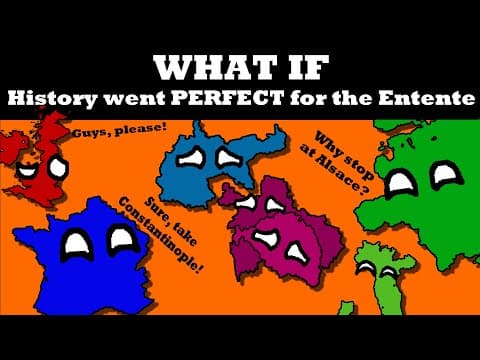
This blog post delves into an alternate history scenario where the Entente powers achieve a perfect outcome in World War I. It examines the implications of strategic decisions, military actions, and diplomatic maneuvers that lead to a swift victory over the Central Powers, reshaping Europe and the Middle East in the process.
A year ago, I explored a scenario where everything went perfectly for the Central Powers during World War I. Today, we will examine the opposite side of the conflict: what if everything went perfectly for the Entente? This exploration is more complex than it may seem, as it requires a careful consideration of historical events and their implications.
The Entente, primarily composed of France, Russia, and Britain, later joined by Italy, faced a formidable Central Powers alliance of Germany, Austria-Hungary, Bulgaria, and the Ottoman Empire. Unlike the Central Powers, whose goals were more unified, the Entente's diverse national ambitions complicate the scenario. For simplicity, we will focus on the major powers: France, Russia, Britain, and Italy, while acknowledging Japan's limited role and the absence of the United States in this timeline.
To create a plausible alternate history, we will start around 1914, maintaining the assassination of Archduke Franz Ferdinand as the catalyst for the conflict. The Entente was initially the underdog, and any significant changes before 1914 could alter the war's trajectory too drastically.
In our timeline, the German invasion of France followed the Schlieffen Plan, which aimed to quickly defeat France before turning to the Eastern Front. However, this plan was adapted, sparing the Netherlands from invasion. In our alternate scenario, we propose that Germany invades the Netherlands, creating a broader front. The Dutch army, unprepared for a full-scale conflict, would retreat, allowing German forces to advance. However, this diversion would stretch German resources thin, ultimately leading to a stalemate on the Western Front.
As the war progresses, the Balkans become a critical theater. Historically, Bulgaria sided with the Central Powers due to better territorial promises. In our scenario, the Entente must present a united front to win Bulgaria over. By offering clear territorial gains and diplomatic support, the Entente could sway Bulgaria to join their side, significantly weakening the Central Powers' position.
With Bulgaria on the Entente's side, the Ottoman Empire faces immense pressure. The fall of Istanbul becomes inevitable as Entente forces advance from multiple fronts. This collapse would not only secure the Balkans for the Entente but also open new supply routes for Russia, bolstering their war effort.
In this alternate timeline, Britain opts for a more aggressive naval strategy. Instead of focusing solely on mobilizing a conscript army, Britain implements a blockade of Germany, cutting off vital supplies. This blockade is more effective due to the absence of Dutch neutrality, leading to a significant weakening of the German war economy.
Britain's strategy involves blockading the North Sea and utilizing smaller ships to control the Baltic Sea. By threatening Denmark to respect its neutrality, Britain can secure vital shipping routes. This plan, while risky, could lead to a decisive naval victory, further isolating Germany and supporting Russian efforts on the Eastern Front.
By 1916, the Ottoman Empire collapses, and the Entente's victories embolden their forces. Romania joins the war, adding pressure on Austria-Hungary. The Central Powers, facing multiple fronts and dwindling resources, begin to falter. Kaiser Karl of Austria-Hungary recognizes the inevitable defeat and seeks a negotiated peace, leading to a different outcome than in our timeline.
With the Central Powers on the brink of collapse, the peace negotiations take a harsher turn. Russia, emboldened by its victories, demands significant territorial gains, including Istanbul. The Entente powers, particularly Britain and France, support Russia's claims, leading to a reconfiguration of borders in Eastern Europe and the Middle East.
The Ottoman Empire is partitioned decisively, with Russia gaining control of Istanbul and significant territories in Anatolia. Britain and France also secure their interests, with Britain expanding its influence in the Middle East and France establishing a presence in Syria. The absence of the League of Nations means these territories are treated as colonies rather than mandates, leading to a more direct control over the region.
In Europe, the defeat of the Central Powers leads to significant territorial changes. Bulgaria, having seized Serbian territories, becomes a pariah state, while Serbia and Greece expand their borders. Italy gains influence in the region, countering the rise of Russia. The Habsburg Empire, while not completely dismantled, suffers significant territorial losses and internal strife, leading to its eventual collapse.
Germany faces severe repercussions, losing territories and facing economic hardships. The Treaty of Versailles, in this timeline, is far harsher, with France gaining control over the Rhineland and Denmark annexing territories. Britain, wary of a rising Russia, seeks to preserve a balance of power in Europe, leading to a complex post-war landscape.
In this alternate history, the Entente's perfect outcome in World War I reshapes Europe and the Middle East, leading to a different geopolitical landscape. The absence of American intervention and the decisive victories of the Entente powers create a scenario where the balance of power shifts dramatically. As we conclude this exploration, the implications of this alternate timeline raise questions about the future of international relations and the potential for conflict in a world shaped by different historical choices.



















