
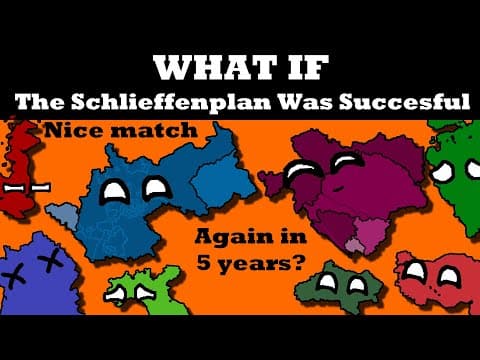
This blog post delves into the hypothetical scenario where Germany successfully executes the Schlieffen Plan, leading to a swift victory over France by Christmas 1914. It examines the implications of such a victory on Europe, the peace treaties that might follow, and the geopolitical landscape that would emerge, contrasting it with the actual outcomes of World War I.
The idea of ending World War I before Christmas is a classic theme in alternate history discussions. Many creators have explored the concept of Christmas truces, emphasizing the camaraderie among soldiers rather than the political machinations that fueled the war. However, this post takes a different approach by examining what might have happened if Germany had successfully executed the Schlieffen Plan and defeated France by the end of 1914.
Before the war began, many nations were enthusiastic about the conflict, particularly Germany, which was confident in its military strategy. The Schlieffen Plan aimed to quickly defeat France and then turn to the Eastern Front against Russia. If the plan had succeeded, it could have led to a rapid German victory, potentially forcing France to capitulate before Christmas.
However, the assumption that France would surrender upon losing Paris is overly simplistic. Even if Paris fell, the French government had already relocated to Bordeaux, and as long as Britain and Russia remained in the war, France would likely continue to fight. A German capture of Paris could lead to a disastrous situation for Germany, as they would have to defend a city of millions on an uneven front line.
If we entertain the scenario where the Schlieffen Plan leads to a significant German victory, several outcomes could unfold:
French Army Decimation: If Germany managed to incapacitate the French army significantly, they could negotiate a peace treaty. However, the nature of this treaty would depend on various factors, including the balance of power and the willingness of Britain and Russia to continue the fight.
Peace Treaty Dynamics: Historically, short wars tend to produce milder peace treaties. However, in this alternate scenario, Germany would hold significant leverage over France, potentially leading to harsh terms. The September Program outlined Germany's ambitions, including territorial gains and reparations from France.
A decisive German victory in 1914 would drastically alter the geopolitical landscape of Europe:
Britain's position would be precarious. Despite losing the war, it would still possess a strong economy, but its ability to counterbalance Germany's newfound power would be limited. The traditional British dominance in Europe would be challenged, leading to a re-evaluation of alliances and strategies.
In this alternate history, a decisive German victory in 1914 would set the stage for a new European order, characterized by German hegemony and a weakened France. The implications of such a scenario would resonate through the decades, reshaping alliances and conflicts in ways that could lead to further instability. While this exploration of an alternate timeline is speculative, it highlights the fragile nature of historical events and the profound impact of military strategies on global politics.
As we reflect on this hypothetical outcome, it serves as a reminder of the complexities of war and peace, and the delicate balance of power that shapes our world.



















