
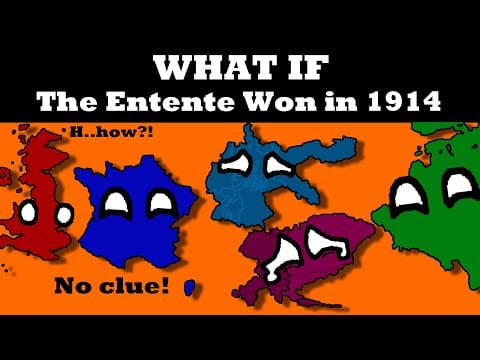
This blog post delves into an alternate history scenario where the Entente powers achieve a swift victory in World War I. It examines the implications of such a victory on Germany, Austria-Hungary, Russia, France, and Britain, and how the geopolitical landscape of Europe might have changed as a result.
In this exploration of alternate history, we consider a scenario where the Entente powers—comprising France, Britain, and Russia—achieve a swift victory in World War I, contrasting with the historical success of the German Schlieffen Plan. This analysis will examine the potential outcomes of such a victory, the implications for the involved nations, and how the geopolitical landscape of Europe might have shifted.
World War I began in 1914, characterized by complex alliances and military strategies. The German Schlieffen Plan aimed for a quick victory by invading France through Belgium, while the Entente powers relied on a more prolonged strategy, allowing for mobilization and resource accumulation. The French War Plan 17, which was poorly conceived, aimed to invade Germany directly but failed in execution.
In our alternate scenario, we assume that the French War Plan 17 succeeds. Germany, initially confident in its offensive through Belgium, faces unexpected resistance as France breaks through in Alsace. The German forces, overextended and disorganized, are forced to retreat, leading to a significant shift in the war's momentum.
As the German Western Army suffers heavy losses, they are compelled to establish defensive positions. Meanwhile, the Russians, instead of facing a swift defeat, manage to focus their efforts on Austria-Hungary, inflicting severe losses and capturing significant territory. This shift in the Eastern Front allows the Entente to maintain the initiative.
With the German offensive faltering, the leadership in Berlin begins to contemplate surrender. The dynamics of the war change dramatically, as Germany, now on the defensive, seeks a negotiated peace. The negotiations would likely involve Britain, which had a vested interest in stabilizing Europe rather than completely dismantling Germany.
The peace terms in this scenario would be considerably lighter for Germany compared to the historical Treaty of Versailles. Key territorial losses would include:
Despite losing the war, Germany retains much of its territory and military capability. The government faces internal challenges, particularly from the growing socialist movement, which could exploit the defeat to push for reforms or greater democracy. However, the monarchy remains intact, and Germany continues to be a significant power in Europe.
Austria-Hungary, having suffered significant losses, faces existential threats from within. The defeat against both Russia and Serbia could catalyze nationalist movements, leading to demands for independence from Hungary and other ethnic groups. The empire's stability is severely compromised, making its collapse likely.
Russia emerges from the conflict in a stronger position, having successfully defeated Austria-Hungary and expanded its influence. Tsar Nicholas II, emboldened by victory, may attempt reforms, although historical tendencies suggest he would resist significant changes.
France, having achieved its objectives, experiences a sense of euphoria. The war's limited impact on French soil allows its economy to remain intact, reducing the fervor of the Franco-German rivalry. France's reliance on Russia diminishes, as it no longer feels threatened by Germany.
Britain, having entered the war with minimal losses, finds itself in a favorable position. The balance of power shifts, as Britain no longer views Germany as its primary rival. Instead, it may focus on managing the rising influence of Russia and maintaining stability in Europe.
The aftermath of this alternate war scenario leads to a complex geopolitical landscape. The unresolved tensions from the conflict continue to simmer, with potential for future conflicts. The rise of Serbia as a regional power and the instability in Austria-Hungary could lead to further confrontations in the Balkans.
The 1920s and 30s in Europe would likely be marked by uncertainty. The issues that led to World War I remain unresolved, with the potential for new conflicts arising from the shifting alliances and power dynamics. Britain may seek to realign its alliances, potentially forming new partnerships to counterbalance Russian influence.
In this alternate history scenario, the swift victory of the Entente powers in World War I leads to significant changes in the geopolitical landscape of Europe. While Germany remains a formidable power, the collapse of Austria-Hungary and the rise of Serbia create new challenges. The long-term implications of this conflict would shape the course of European history, highlighting the complexities of international relations and the enduring nature of historical grievances.



















