
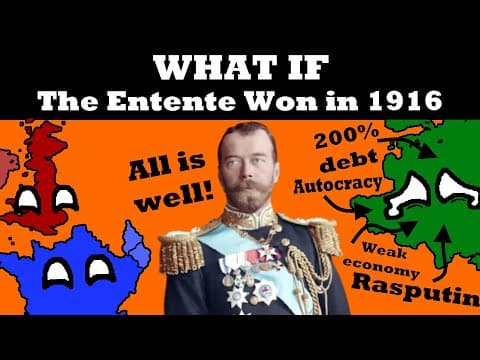
This blog post delves into an alternate history where the Entente powers won World War I in 1916, examining the geopolitical and economic consequences of a shorter war, the fate of major powers, and the potential for future conflicts.
In this exploration of an alternate timeline, we consider a scenario where the Entente powers—Britain, France, Russia, and Italy—achieved victory in World War I by 1916. This victory significantly alters the post-war landscape, particularly by excluding the United States from the conflict and leading to a harsher peace for the Central Powers. This post will analyze the implications of this alternate history, focusing on the geopolitical and economic consequences that arise from a shorter war.
Initially, the Entente was a simple alliance between France and Russia, later joined by Britain and its empire. As the war progressed, this alliance evolved into a broader coalition against the Central Powers. In our alternate timeline, the Entente's victory occurs earlier, resulting in a different peace settlement and a reconfiguration of Europe.
In this scenario, both Russia and France advocate for severe consequences for Germany, contrasting sharply with the more lenient approach favored by the United States in our timeline. The peace deal includes:
One of the most significant outcomes of this alternate timeline is the war's duration, which is nearly two years shorter than in our actual history. This reduction leads to fewer casualties and a more favorable economic situation globally.
In our timeline, Britain incurred massive debt due to the war, with a debt-to-GDP ratio soaring to 180%. In the alternate timeline, the shorter conflict means that Britain's financial burden is significantly lighter, allowing for a more stable post-war economy. Conversely, Russia's debt, which escalated to over 175% of GDP during the war, would also be less severe, but the country still faces substantial economic challenges due to the war's devastation.
The absence of American loans, which were crucial in our timeline for post-war recovery, means that Europe faces a different economic landscape. While the U.S. economy remains robust, the Roaring Twenties may not be as prosperous due to reduced European demand for American goods. This scenario could lead to a more contained economic downturn in the U.S., with Japan facing significant challenges due to its reliance on American trade.
Following the war, Germany finds itself in a precarious position. The Kaiser is likely to be overthrown, leading to the establishment of a new democratic regime. However, revanchism and the desire to reclaim lost territories will be prevalent, setting the stage for future conflicts.
In this alternate timeline, France and Britain are more united against a potentially aggressive Germany. The dynamics of international relations shift, with Britain possibly favoring cooperation with Germany if it remains democratic, contrasting with their historical stance of isolation.
The fall of Tsar Nicholas II is a pivotal moment in this alternate history. The potential for a Russian Republic emerges, which could either stabilize the nation or lead to further chaos. The success of this republic hinges on economic reforms and the ability to manage nationalist movements within the empire.
In this alternate world, the likelihood of major global conflicts diminishes, but minor skirmishes may arise, particularly in Eastern Europe. The balance of power shifts, with a stronger Russia potentially countering Japanese expansion in Asia.
With a more robust British economy and a less aggressive France, the two nations could work together to maintain stability in Europe. The absence of a strong Russian presence might embolden Germany, but the collective strength of the Entente powers could deter any aggressive moves.
This exploration of an alternate history where the Entente won World War I in 1916 reveals a complex web of geopolitical and economic consequences. The shorter war leads to a different balance of power in Europe, with potential for both cooperation and conflict. The fate of nations like Russia and Germany hangs in the balance, influenced by the decisions made in the aftermath of the war. As we reflect on these possibilities, it becomes clear that the course of history is often shaped by the smallest of changes, leading to vastly different outcomes.



















