This blog post takes readers on a captivating journey through China's hidden landscapes, exploring sacred mountains, unique wildlife, and ancient cultural sites. From the majestic Golden Buddha of Mount Emei to the elusive cloud panther, discover the secrets of China's natural beauty and spiritual heritage.
China is a land where villages hidden between mountains keep secrets that not even the residents themselves know. This blog post embarks on a visual journey through places so remote and mysterious that they seem like something out of a movie. It is an expedition into the empire of spectacular places and enigmatic beings, such as the cloud panther and the taquim, that walk among the rocks with the grandeur of legendary creatures. This is not just a trip through the East; it is an exploration of its best-kept secrets.
Our first stop is in the province of Siuan, where the majestic Mount Emei rises, one of the four sacred mountains of Buddhism. At the highest point of the mountain stands the great Golden Buddha of Samanta Badra, one of the largest religious sculptures in China. This imposing figure shines among the clouds, visible from kilometers away, especially when it emerges majestically through the fog.
The atmosphere around Mount Emei is one of introspection. The wind carries the aroma of incense and the sound of temple bells, creating a serene environment where visitors often find themselves in silent contemplation, moved by the transcendental experience this place offers.
Among the mist-shrouded pine trees and hidden cliffs of Mount Emei live creatures that embody the same aura of mystery. The cloud panther, a medium-sized feline with fur in shades of gray and gold, is adapted to life in the treetops. Its powerful paws and long tail allow it to navigate the branches with agility, making sightings extremely rare.
Another inhabitant of Mount Emei is the taquim, a creature that resembles a fusion of goat and antelope. Known for its unpredictable behavior, the taquim is a master climber, moving with surprising agility along the rocky slopes. Its fur secretes a natural oil during colder months, providing protection from humidity.
In the lower areas of the mountain, among ancient temples and stone-carved trails, curious groups of monkeys known as Jesus monkeys appear. Agile and intelligent, these primates have become part of the cultural and spiritual landscape of Mount Emei. They are often seen as spiritual guardians or tricksters sent by the gods to test human patience. Scientifically, they hold significance as the first living beings successfully cloned from differentiated cells, sharing 93% of their DNA with humans.
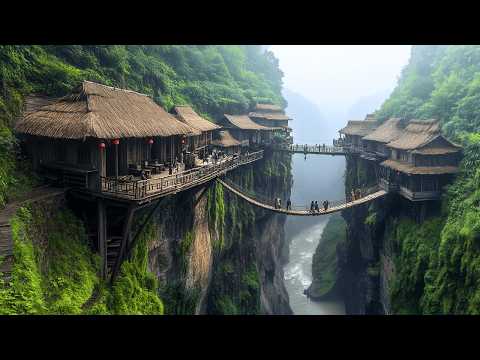
Next, we travel to Fengang, a city founded over 1,300 years ago, where natural beauty intertwines with a carefully preserved historical heritage. The stone streets, suspended houses, and arched bridges reflect the Ming and Qing dynasties. Fengang symbolizes the perfect union between nature, culture, and spirituality, with its wooden buildings following the contours of the Tuodiang River.
As night falls, the elusive Bengalese prionailurus, or leopard cat, emerges from the surrounding forests. This small feline, almost the size of a domestic cat, is known for its beauty and mystery, making it a rare sight.
Walking through the damp fields nearby, one might hear the sharp sound of wings—a common pheasant, one of the most dazzling birds in Asia. With its metallic tones of green, copper, and gold, this bird is agile and territorial, preferring to run before taking flight when danger approaches.
Further along, we encounter the Ruc waterfall, considered one of the most impressive in China. Located on the border between the provinces of Xanchi, its strength comes from the mass of muddy water that collapses violently during winter, creating natural ice sculptures. In summer, the waterfall's power increases, producing vapors that rise as if the river were boiling.
In the province of Guangong, the impressive Danchia mountain stands as a distinct natural setting, part of the remarkable Dancha relief system recognized as a UNESCO World Heritage site. This geological complex impresses visitors with its rare red sandstone formations, inviting both admiration and introspection.
Among the silences of Danchia mountain, the European otter emerges, agile and curious. This creature can hold its breath for up to eight minutes and is adapted to see in murky waters, gliding through the streams as if part of the landscape.
Mount Tai is known as the closest point between the human and the divine. Pilgrims and tourists alike seek stunning views and a reunion with the spirituality that shaped Chinese culture. The trails of Mount Tai are adorned with over 2,000 inscriptions left by emperors, recording prayers, poems, and philosophical commandments.
The sunrise at Mount Tai is a highly anticipated event, as the darkness of dawn gives way to the orange tones of daybreak. The clouds part like curtains, revealing a sky on fire, creating a transcendental experience for those fortunate enough to witness it.
Among the forests and misty valleys of Shandong province, the Sika deer walks lightly. In local culture, this animal symbolizes longevity and prosperity, often depicted in temples and art. These deer prefer the gloom of the forests but sometimes appear among bamboo groves at dusk, resembling forest spirits.
Hidden among the undulating reliefs of the province of Situan, Mount Mian is more than beautiful; it is a symbol of faith venerated by both Buddhists and Taoists. Ancient temples and stone staircases carry the mark of devotion, while the confluence of the Mim Dadu and Qingi rivers hosts the monumental Great Buddha of Leshan, a 71-meter-high sculpture carved directly into the mountain face.
In the northwest of China lies Qinghai Lake, the largest lake in the country. In spring, it transforms into a natural stage for bird watching, with over 200 species passing through. The vibrant vegetation blooms quickly, creating a multicolored carpet that lasts only a few weeks.
Amidst this ephemeral beauty, the large crow stands out as an ancient resident of the highlands. Known for its intelligence, this bird can recognize human faces and solve complex problems, showcasing the resilience of life in these harsh conditions.
In the province of Runan, the fascinating geological park of Jang Jagier features colossal rock formations shaped by nature over millions of years. Legends of sleeping giants and guardian spirits add a mystical aura to this landscape, making it a place of imagination and wonder.
Hidden among the hills of Guijou, the Juangoschu waterfall is one of the largest in Asia, offering views from above, behind, and below. The sound of the water reverberates through lush vegetation, while rainbows created by the mist add to the spectacle.
On the slopes of Wujou mountain in Shanxi province lie the Yungang caves, carved between the 5th and 6th centuries. These caves house around 51,000 Buddhist statues, each reflecting the depth of faith and culture of the Northern dynasty. The natural setting enhances the mysterious atmosphere, making the caves a testament to the propagation of Buddhism in China.
Little known outside of Asia, the Rulumbuir grasslands in Inner Mongolia form one of the largest continuous natural grasslands in the world. During summer, herds of horses gallop across the landscape, while winter transforms it into a surreal scene covered in snow.
Sunrise and sunset in the grasslands are not just natural events; they are ceremonies of light. The dawn bathes the landscape in golden tones, while dusk paints the horizon with soft oranges and deep blues, creating a work of art in constant movement.
This is the great China, a land full of natural wonders, expressions of history, and human ingenuity. Each destination is a gateway to a separate world where the past and present meet in the beauty of this remarkable country.