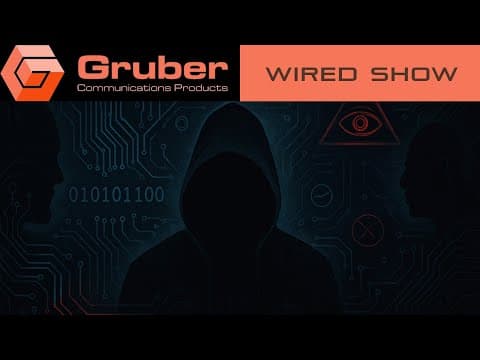
This blog post delves into various conspiracy theories discussed in the Gruber Wired Hour Podcast, including the health impacts of 5G, vaccine-related theories, AI's potential takeover, and the new 'green charge' conspiracy involving biometric tracking at EV charging stations.
In a recent episode of the Gruber Wired Hour Podcast, hosts Mark Beach and John Dodson explored the intriguing world of conspiracy theories. With a mix of humor and skepticism, they discussed various theories ranging from the health impacts of 5G technology to the implications of artificial intelligence and the latest conspiracy surrounding electric vehicle charging stations. This blog post summarizes their conversation, providing insights into these theories and the discussions surrounding them.
One of the most prevalent conspiracy theories discussed was the claim that 5G technology is responsible for health problems, including cancer. Mark and John noted that while this theory circulates widely, they have not encountered any concrete evidence linking 5G to health issues. In fact, they pointed out that vandalism against 5G towers has occurred in some areas due to these beliefs. They emphasized that we live in a world filled with various frequencies and radio waves, suggesting that the technology itself is not the primary concern.
The hosts also touched on the so-called "Battery Gate" conspiracy, which revolves around the idea that companies like Apple and Samsung intentionally throttle device performance to encourage users to purchase new products. This theory gained traction when Apple admitted to slowing down older devices, confirming suspicions of planned obsolescence. Mark compared this to the automotive industry, where components like alternators are designed to fail after a certain period, ensuring continued revenue for manufacturers.
The conversation then shifted to the controversial theory linking vaccines to autism. John highlighted two aspects of this theory: one suggesting that vaccines cause autism and another claiming that vaccines contain microchips for tracking purposes. While acknowledging the ongoing debate, he pointed out that the increase in autism diagnoses may be attributed to better awareness and diagnostic criteria rather than solely to vaccines.
As the discussion progressed, the hosts examined the theory that artificial intelligence (AI) could take over the world. John expressed skepticism about AI developing consciousness, arguing that humans would still need to control these technologies. However, he acknowledged the potential for AI to manipulate data and influence behavior, raising concerns about the unknown capabilities of AI systems.
Another conspiracy theory discussed was the idea of government control over weather patterns, often associated with chemtrails. Mark noted that while cloud seeding is a documented practice, the broader claims of weather manipulation remain unproven. He expressed skepticism about humanity's ability to control weather on a large scale, suggesting that such beliefs may stem from a misunderstanding of environmental science.
The hosts also addressed the theory that smart devices are constantly spying on users. John shared personal anecdotes about how targeted advertisements seem to appear after discussing specific topics, reinforcing the belief that these devices collect data. They acknowledged that many people are concerned about privacy in an age where technology is omnipresent.
Mark and John discussed the implications of deep fake technology, which can create realistic but false representations of people. They warned that as this technology advances, it may become increasingly difficult to discern truth from fiction, leading to a post-truth era where skepticism and research become essential.
The conversation also touched on the idea that big tech companies use algorithms to control user behavior. John pointed out that social media platforms curate content based on user preferences, potentially creating echo chambers that reinforce existing beliefs. This manipulation of information can have significant implications for public discourse and individual perspectives.
Finally, the hosts introduced a brand new conspiracy theory dubbed the "green charge conspiracy." This theory posits that government agencies, major automotive companies, and chip manufacturers are colluding to embed biometric tracking and AI modules in public electric vehicle (EV) charging stations. By 2026, they claim, this could lead to real-time health and behavior profiles of millions of drivers under the guise of grid optimization. The discussion highlighted recent leaks and pilot programs that suggest there may be some validity to these claims, raising questions about privacy and data collection in the age of electric vehicles.
The episode concluded with a reminder for listeners to educate themselves about conspiracy theories, as there may be elements of truth within them. Mark and John encouraged skepticism and critical thinking, especially in a world where misinformation can spread rapidly. As they wrapped up, they posed a thought-provoking question: Are we living in a computer simulation? This question reflects the ongoing exploration of reality and perception in our technologically driven society.