
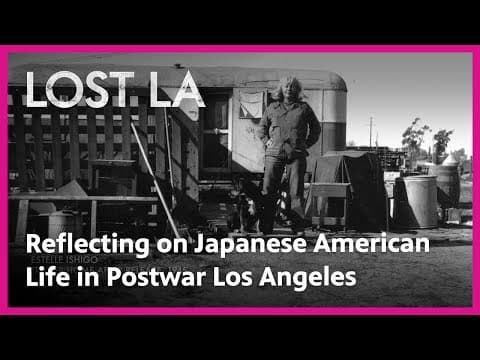
Estelle Ishigo, a white woman married to a Japanese-American man, documented the experiences of Japanese Americans in postwar Los Angeles, particularly focusing on their life in trailer installations after being incarcerated during World War II. Her artwork captures the struggles and resilience of this community as they adapted to their new circumstances while maintaining cultural traditions.
Estelle Ishigo was a remarkable figure in the history of Japanese American experiences during and after World War II. As a white woman married to a Japanese-American man, she chose to accompany her husband to an incarceration camp, demonstrating a profound commitment to her family and community. This blog post delves into her life and the artistic documentation of Japanese American life in postwar Los Angeles, particularly focusing on the trailer installations where many returned after the war.
During World War II, Japanese Americans faced severe discrimination and were forcibly removed from their homes, leading to their incarceration in camps across the United States. Estelle Ishigo and her husband were among those who were sent to Hart Mountain, Wyoming. After the war, they returned to Los Angeles, where they lived in several trailer installations set up across Southern California.
The trailer installations were a temporary solution for many Japanese Americans returning from the camps. There were seven such installations established in Southern California, including locations in Burbank, Hawthorne, Long Beach, and Torrance. Notably, one of these installations was located in what is now the long-term parking area at Burbank Airport.
The conditions in these trailer installations were often described as worse than those in the concentration camps. Many families faced significant challenges, including inadequate housing and limited resources. For instance, in Harbor City, one installation may have been operated by a private company that provided both employment and housing for returnees.
Residents lived in cramped trailers, reminiscent of campers used for vacations, but they were forced to endure these living conditions for months on end. Ishigo's artwork captures these realities, showcasing the struggles of families who had to move multiple times within a few years, highlighting the upheaval they experienced.
Despite the hardships, the Japanese American community maintained their cultural traditions. One poignant example captured by Ishigo is the tradition of pounding mochi, a pounded rice cake that symbolizes good luck for the upcoming year. In her artwork, we see residents participating in this activity against the backdrop of their trailers, illustrating how they preserved their cultural identity even in difficult circumstances.
The act of pounding mochi is not just a culinary tradition; it represents resilience and hope. It is a reminder that, regardless of their living conditions, the community continued to celebrate their heritage and find joy in their cultural practices. Ishigo's documentation serves as a powerful testament to the strength and spirit of the Japanese American community during this challenging period.
Estelle Ishigo's artistic representation of Japanese American life in postwar Los Angeles provides a unique and valuable perspective on the experiences of those who were incarcerated during World War II. Her work not only documents the struggles faced by the community but also highlights their resilience and commitment to preserving their cultural traditions. Through her lens, we gain insight into a significant chapter of American history that continues to resonate today.



















