
This article delves into four of the most bizarre and unconventional warships in history, including the massive Japanese I-400 submarine aircraft carriers, the Italian monitor Fard Bruno, the British Colossus class battleships, and the USS Wolverine, a converted paddle steamer that served as a training aircraft carrier during WWII. Each vessel showcases unique designs and innovative concepts that pushed the boundaries of naval engineering.
Warships have evolved significantly over the centuries, with many designs pushing the boundaries of conventional naval architecture. In this article, we will explore four of the most bizarre and unconventional warships in history, showcasing their unique features and the innovative thinking behind their designs.
Conventionally, submarines have been small vessels designed for stealth and maneuverability. However, in August 1945, sailors aboard two US destroyers were shocked to detect the largest submarine ever built: the Japanese I-400 class. Measuring 400 feet long and 39 feet wide, these submarines were capable of impressive feats, including a surface speed of 19 knots and a cruising range that could circle the globe one and a half times before needing to refuel.
The I-400 class submarines were not just large; they were designed to carry aircraft. This concept was championed by Admiral Isoroku Yamamoto, who sought to maintain Japan's military successes against the United States after the Pearl Harbor attacks. The idea was to launch aircraft from submarines, allowing Japan to strike American cities without being detected.
The submarines could carry three specially designed I-16A Siran floatplanes, which could be launched via catapult and retrieved using collapsible cranes. Despite their innovative design, the I-400s were unwieldy and difficult to maneuver, making them vulnerable in combat situations.
Only three I-400 class submarines were completed by the end of World War II, and they never had the chance to fulfill their intended purpose. Their final mission was to attack the US Navy base at Apra Harbor, but Japan's surrender rendered this plan moot. After the war, the submarines were scuttled to prevent Soviet capture, and their remains were discovered in 2013.
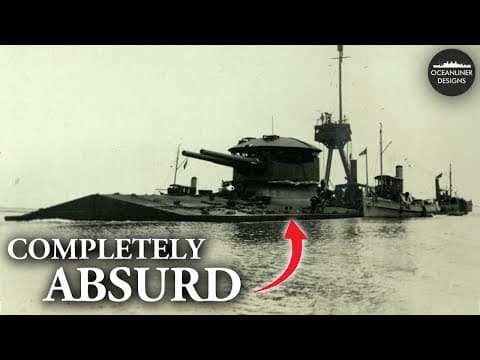
Monitors are warships designed for shallow coastal operations, and the Italian Fard Bruno is one of the strangest examples. Built during World War I, the Fard Bruno was a unique vessel that combined heavy artillery with a low profile to minimize its visibility.
The Fard Bruno was powered by discarded steam engines from British torpedo boats, achieving a maximum speed of just 3.3 knots. Its hull was designed with a prismatic shape for added protection, and it featured massive 15-inch guns housed in revolving turrets. Despite its unusual design, Italy invested in 14 monitors, including the Fard Bruno, to support their naval operations.
The Fard Bruno participated in the 11th Battle of Isonzo, bombarding Austro-Hungarian positions. Although it played a minor role in the battle's outcome, the monitor's design allowed it to serve effectively as a stable gun platform for nearly 30 years before being scuttled in 1945.
The British Colossus class battleships emerged during a time of rapid naval innovation, characterized by the transition from wooden sailing ships to iron steamships. These battleships were notable for their use of steel in construction and the introduction of breach-loading guns.
The Colossus class was designed to be longer and faster than its predecessors, with a hull that stood tall out of the water. However, this height made the ships prone to rolling and difficult to maneuver. Despite these challenges, the Colossus class represented a significant advancement in naval technology, with impressive firepower and speed.
Although the Colossus class was rendered obsolete shortly after its introduction, it showcased the ambitious spirit of naval architects during a time of fierce competition among world navies.
In a remarkable twist of naval ingenuity, the US Navy converted the SS CNB, a passenger paddle steamer, into the USS Wolverine, a training aircraft carrier during World War II. This unconventional vessel played a crucial role in preparing naval aviators for carrier operations.
The USS Wolverine was transformed from a luxurious passenger ship into a flattop flight deck, complete with arrestor wires for landing aircraft. Operating primarily in the Great Lakes, the Wolverine provided a safe environment for training pilots, despite its limitations as a non-traditional carrier.
The Wolverine trained thousands of pilots who would go on to serve in the Pacific Theater, contributing significantly to the Allied victory. After the war, the vessel was decommissioned and scrapped, but its legacy as a unique training platform endures.
These four warships exemplify the creativity and innovation that have characterized naval design throughout history. From the massive I-400 submarines to the quirky Fard Bruno monitor, each vessel tells a story of ambition, experimentation, and the relentless pursuit of naval superiority. As we continue to explore the fascinating world of naval history, we uncover more examples of unhinged warship designs that have shaped the seas.



















