
This blog post examines the rich history and cultures of Mexico before European contact, focusing on the indigenous peoples, their societies, agricultural practices, and the significant civilizations such as the Olmecs, Maya, and Aztecs. It highlights the complexities of studying pre-Columbian history due to the lack of written records and the impact of European arrival on indigenous populations.
In this lecture, we delve into the history of Mexico before European contact, a period often overlooked in discussions of world history. While the term "medieval" typically evokes images of Europe or Asia, it is essential to recognize the rich and complex societies that existed in the Americas, particularly in Mexico, prior to the arrival of Europeans in the late 15th century.
European contact in the Americas is generally marked by Christopher Columbus's arrival in 1492, when he landed on Hispaniola, which comprises modern-day Dominican Republic and Haiti. However, it wasn't until around 1520 that Europeans reached the Valley of Mexico, the heart of pre-Columbian Mexican civilization. This period, from 1492 to 1520, is crucial for understanding the indigenous cultures that thrived in Mexico before European influence.
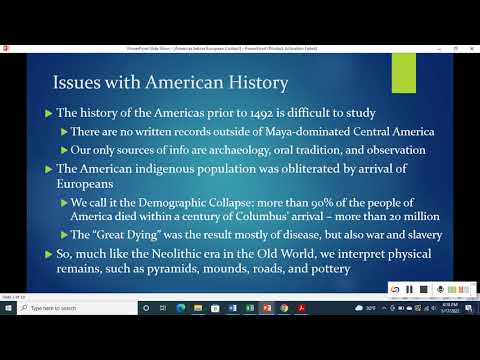
One of the primary challenges in studying American history before European contact is the absence of written records. Most indigenous cultures did not have writing systems, with the notable exception of the Maya, who developed a form of hieroglyphic writing. As a result, historians rely heavily on archaeology, oral traditions, and observations from early European explorers, each of which has its limitations.
Archaeology provides valuable insights into the lives of pre-Columbian peoples, revealing information about their cities, diets, and social structures. However, it cannot answer the more profound questions of why certain events occurred or why societies developed in specific ways. For instance, while we can identify the existence of monumental structures, we cannot ascertain the motivations behind their construction.
Oral traditions, which consist of stories passed down through generations, often contain mythological elements that complicate historical accuracy. While they may hold kernels of truth, distinguishing fact from embellishment can be challenging.
The accounts of Spanish conquistadors, such as Bernal Díaz, provide another perspective but are often biased. These observers were outsiders who may not have fully understood the cultural practices they witnessed, leading to misinterpretations.
The arrival of Europeans had catastrophic effects on indigenous populations, leading to what is often referred to as the "Great Dying." More than 90% of the indigenous population in the Americas perished within a century of Columbus's arrival, primarily due to diseases like smallpox and influenza, to which they had no immunity. This demographic collapse severely limited our understanding of pre-Columbian cultures, as many of the survivors could not recount their histories.
When studying American history, it is crucial to avoid applying European frameworks, such as the concept of distinct ages (Stone Age, Bronze Age, Iron Age). Most indigenous peoples in the Americas were still in the Stone Age by 1492, but this does not imply they were less advanced. For example, the Aztecs utilized obsidian, a volcanic glass, for tools and weapons, which could be sharper than iron.
Despite lacking metal tools, American societies were sophisticated in various ways. They built large cities, developed complex agricultural practices, and established intricate trade networks. The Inca, for instance, constructed the best roads in the world, while the Aztecs created a city on a lake with extensive canals and floating gardens.
The Olmecs, often considered the first major civilization in Mexico, emerged around 1500 BCE along the Gulf Coast. They are known for their colossal stone heads and contributions to art and religion, including the violent mesoamerican ballgame.
The Maya civilization, which began to flourish around 500 BCE, is renowned for its monumental architecture, advanced mathematics, and astronomical knowledge. They were the only indigenous people in the Americas to develop a writing system, allowing them to record their history and achievements.
The Valley of Mexico became the center of indigenous life, where various cultures coexisted and interacted. The region was characterized by a shared pantheon of gods and a religion that emphasized human sacrifice to appease these deities. The Aztecs, who rose to prominence in the 14th century, are particularly noted for their elaborate religious practices and the scale of their human sacrifices.
The Aztec Empire, which began as a confederation of three city-states in 1427, expanded through military conquest and strategic alliances. They ruled indirectly, allowing local elites to maintain power while extracting tribute and enforcing trade monopolies.
Most Aztecs were craftsmen, with only about 20% engaged in agriculture. They utilized chinampas, or floating gardens, to maximize agricultural output, allowing for multiple harvests per year. Markets played a central role in daily life, serving as hubs for trade and social interaction.
Aztec religion was complex, centered around a pantheon of gods, including Quetzalcoatl and Tlaloc. The New Fire Ceremony, held every 52 years, was a significant event that involved extinguishing all fires and rekindling them from a sacrificial victim. Human sacrifice was integral to their belief system, with estimates of thousands of sacrifices occurring annually.
The history of Mexico before European contact reveals a rich tapestry of cultures, societies, and beliefs that were complex and sophisticated in their own right. Understanding this period is crucial for appreciating the profound impact of European arrival and the subsequent transformations that occurred in the Americas. By examining the indigenous peoples of Mexico, we gain insight into a world that existed long before the arrival of Columbus and the Spanish conquistadors.



















