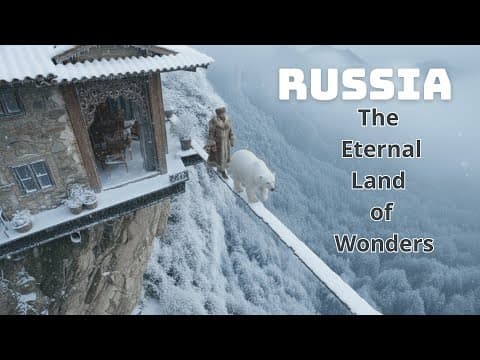
This comprehensive travelogue explores Russia's vast and diverse landscapes, iconic landmarks, and rich cultural heritage. From the historic Red Square and St. Basil's Cathedral in Moscow to the natural beauty of Lake Baikal and the Alai Mountains, the article delves into Russia's history, architecture, and enduring spirit, highlighting the blend of tradition and modernity across the nation.
Russia is not just a place to visit; it is a living, vast, untamed land filled with endless beauty and deep history. From the golden domes shining under the winter sun to ancient forests that seem to remember the beginning of time, Russia offers a unique experience where history is not only written but felt.
Red Square in Moscow is a convergence point of centuries of Russian identity. Enclosed by the striking red bricks of the Kremlin walls, it stretches nearly 900 feet in length and 500 feet in width. The cobblestone expanse is home to iconic landmarks such as the colorful onion domes of St. Basil's Cathedral and the somber Lenin's Mausoleum. Established in the late 1500s, Red Square has witnessed imperial parades, revolutionary uprisings, and millions of footsteps, making it a silent witness to events shaping Russia and the world.
Rising boldly above Red Square, St. Basil's Cathedral embodies cultural fusion and national identity. Its vibrant onion-shaped domes reach nearly 156 feet high, casting a whimsical silhouette. Built in the mid-16th century under Ivan the Terrible to commemorate the capture of Kazan, it symbolizes the unification of diverse cultures under a single religious vision.
At the heart of Moscow, the Kremlin stands as a symbol of enduring power and layered history. Towering red brick walls nearly 70 feet high and golden domes rise above the Moskva River. Commissioned by Ivan the Great in the late 15th century, the Kremlin has witnessed the crowning of tsars and revolutionary dreams. It represents the convergence of power, tradition, and artistry.
Beneath Moscow lies the Moscow Metro, a testament to vision and ambition. Opened in 1935 with 11 stations, it has grown into one of the world's most extensive transit systems. The stations resemble underground palaces adorned with chandeliers, mosaics, and marble columns, blending Soviet-era grandeur with functional efficiency.
Located in St. Petersburg, the State Hermitage Museum is a colossal institution housing over 3 million treasures, from ancient Egyptian sculptures to Renaissance masterpieces. Founded in 1764 by Empress Catherine the Great, it reflects Russia's imperial grandeur and the universal language of creativity.
St. Isaac's Cathedral, completed in 1858, stands as a symbol of resilience and grandeur. Its immense golden dome reaches over 200 feet, with Corinthian columns of polished red granite. The cathedral has witnessed empires and revolutions, serving as a beacon of hope amid change.
Commissioned by Peter the Great in the early 18th century, Peterhof Palace is a dazzling symbol of beauty, power, and cultural identity. Its golden domes shimmer against the Gulf of Finland, surrounded by meticulously landscaped gardens with over 140 fountains. The palace was nearly ruined during World War II but has been restored to its magnificence.
Nestled on Kotlin Island, Kronstadt is a naval fortress city founded by Peter the Great. It has a rich maritime history, with grand Orthodox cathedrals and weathered docks. The city reflects resilience and ambition, standing at the crossroads of national dreams.
The Golden Ring is a collection of ancient towns northeast of Moscow, featuring onion-domed churches, white stone kremlins, and wooden cottages. Towns like Suzdal, Yaroslavl, and Kostroma offer a glimpse into Russia's spiritual roots and rural traditions, blending history with modern life.
Established over 900 years ago, Suzdal preserves its ancient layout and traditional architecture, offering a tranquil escape from modernity.
Founded over 1,000 years ago, Yaroslavl is known for its ancient cathedrals and vibrant riverfront, blending faith and resilience.
A cradle of the Romanov dynasty, Kostroma features golden domes, cobblestone streets, and a mix of historical and Soviet-era architecture.
Lake Baikal, the world's deepest freshwater lake, stretches over 397 miles and is surrounded by dense forests and mountains. Revered by indigenous peoples for over 25 million years, it faces ecological pressures despite its ancient tranquility.
These ancient peaks serve as a crossroads of cultures and history, with petroglyphs dating back over 5,000 years. The mountains offer profound silence and natural beauty, though life here can be harsh, especially in winter.
Home to over 160 volcanic peaks and geysers, Kamchatka is a land of untamed wilderness. Indigenous peoples have adapted to its harsh conditions, and the region remains sparsely populated with rich geothermal activity.
Sochi, located on the Black Sea coast, is known for its pebble beaches, palm-lined promenades, and proximity to the Caucasus Mountains. It gained global recognition after hosting the 2014 Winter Olympics. Nearby, Sochi National Park preserves unique species and natural landscapes, balancing urban development with wilderness.
Located on Lake Onega, Kizhi Island is famous for its wooden churches built without nails, showcasing Orthodox devotion and craftsmanship from the 18th century.
Stretching over 1,600 miles, the Urals mark the natural divide between Europe and Asia. They have been a site of exploration, migration, and industrialization, with mining towns nestled among ancient wilderness.
Known for its ancient folklore and natural beauty, Karelia features vast lakes, pine forests, and granite boulders. It has a complex history shaped by Swedish and Russian rule.
Located near Moscow, this monastery combines spiritual endurance with historical significance, serving as both a fortress and religious site.
Founded in 1991, this park preserves ancient wooden chapels and farmsteads, reflecting a harmonious relationship between humans and nature.
A sacred site on Lake Baikal, Olkhon Island is revered by the Buryat people and known for its dramatic cliffs and spiritual significance.
Situated in the Russian Arctic, Murmansk is a strategic port city with a rich history, including its role in World War II. It contrasts urban life with the surrounding tundra.
The largest city in Siberia, Novosibirsk developed rapidly with the Trans-Siberian Railway. It features a mix of Soviet-era and modern architecture and serves as a cultural hub.
Founded in 1723, Yekaterinburg is a center of metallurgy and industrial might. It is also known for the Church on the Blood, marking the site of the last Russian tsar's execution.
Located in Pushkin, near St. Petersburg, the Catherine Palace is a symbol of imperial opulence and resilience. Its blue and gold facade and the recreated Amber Room reflect Russia's complex history.
Stretching nearly 5,774 miles from Moscow to Vladivostok, the Trans-Siberian Railway unifies Russia's diverse regions. It passes through forests, steppes, and urban centers, symbolizing human connection across vast distances.
Russia is a land of contrasts and continuity, where ancient traditions meet modern aspirations. Its vast landscapes, historic cities, and cultural landmarks tell stories of resilience, faith, and transformation. From the bustling streets of Moscow to the serene shores of Lake Baikal, Russia invites travelers to explore its eternal wonders and discover the soul of a nation shaped by history and nature alike.