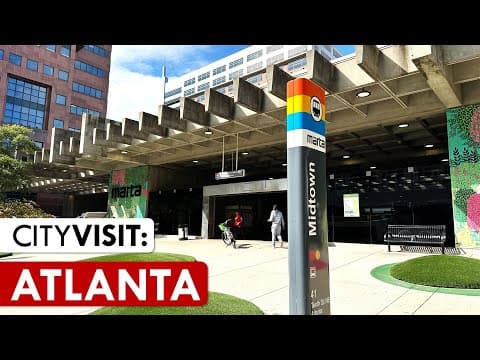
The Atlanta Beltline is a transformative urban trail that showcases the beauty and contradictions of Atlanta. This blog post explores the city's unique neighborhoods, the challenges of its transit system, and the vibrant culture surrounding the Beltline, highlighting its potential as a model for urban development and active transportation.
Atlanta, Georgia, is home to what many consider the best urban trail in the United States: the Atlanta Beltline. This trail not only connects various neighborhoods but also reflects the complexities and contradictions of the city itself. In this blog post, we will delve into the unique aspects of Atlanta, its neighborhoods, and the challenges faced by its transit system, particularly focusing on the Beltline's role in urban development and community engagement.
Starting in downtown Atlanta, one encounters a peculiar mix of late 20th-century office buildings and vibrant tourist attractions. The area features the America's Mart wholesale trade center, which operates almost like a city within a city, complete with a chaotic assortment of sky bridges. Nearby, Centennial Olympic Park serves as a hub for various attractions, including a museum dedicated to the city's famous nutritional product.
The downtown sports venues, such as State Farm Arena and Mercedes-Benz Stadium, are well-connected to the MARTA transit system, although the urban fabric connecting them to the surrounding areas is still a work in progress. The ongoing construction of Centennial Yards, a mixed-use district, aims to enhance this connection in time for the 2026 World Cup.
MARTA, Atlanta's transit system, is often criticized for its limited reach and ridership. Despite its good service frequency, particularly in the core areas, many residents do not utilize it. Factors contributing to this include the system's historical roots, which date back to the 1970s, and its inability to efficiently connect to popular destinations.
The land use around many outlying stations is not conducive to high ridership, often consisting of large parking lots rather than walkable neighborhoods. This has resulted in a car-dependent culture, with traffic congestion being a significant issue throughout the city, particularly in Midtown.
Midtown Atlanta showcases a blend of historic streetcar-era buildings and modern high-rise developments. This area is characterized by its vibrant cultural scene and walkable neighborhoods, with Piedmont Park serving as a central green space reminiscent of Central Park. Midtown was once the original streetcar destination, and its urban form still reflects that legacy.
However, the impact of the vanished streetcar system is evident, as neighborhoods that once thrived on public transit are now some of the most desirable places to live. Inman Park, for instance, features a preserved trolley barn but lacks the density needed to support the nearby MARTA station effectively.
The Atlanta Beltline is a significant urban development project that repurposes old rail corridors into a vibrant trail for pedestrians and cyclists. It serves as a hybrid of an active transportation facility and a linear park, encouraging exercise and community engagement. The Beltline's design incorporates elements of urban design, landscape architecture, and public art, making it a unique space for both recreation and transportation.
As one traverses the Beltline, it becomes clear that it is not just a trail but a catalyst for development. The surrounding areas have seen a surge in housing and retail, with food halls and markets becoming popular destinations. However, the proliferation of food halls raises questions about the future of dining experiences in urban settings.
Despite its success, the Beltline faces challenges, particularly regarding transit accessibility. The absence of MARTA stations along the trail has led to increased car dependence, as visitors from across the metro area drive to enjoy the space. This raises concerns about the sustainability of Atlanta's transportation model and the need for improved public transit options.
Additionally, the Beltline's popularity has sparked debates about its future, with some advocating for the integration of rail transit to enhance connectivity. The ongoing discussions reflect a broader question about how Atlanta will address its growing traffic issues while promoting sustainable urban development.
The Atlanta Beltline stands as a testament to the city's potential for transformation and community engagement. It highlights the beauty and contradictions of Atlanta, showcasing its rich history while paving the way for a more sustainable future. As the city continues to evolve, the Beltline may serve as a model for other urban areas seeking to balance development, transit, and community needs.
In the words of Dr. Martin Luther King Jr., "The arc of the moral universe is long, but it bends toward justice." As Atlanta navigates its complexities, the hope is that it will continue to bend toward a more just and equitable urban landscape.