
This article delves into various secret societies throughout history, exploring their beliefs, practices, and impacts on society. From the Knights Templar to modern organizations like the Church of Satan, each group has unique philosophies and legacies that continue to intrigue and inspire conspiracy theories.
Secret societies have long captivated the imagination of people around the world. From medieval military orders to modern occult groups, these organizations often operate in secrecy, leading to a plethora of myths, legends, and conspiracy theories. This article explores some of the most notable secret societies throughout history, their beliefs, practices, and the legacies they left behind.
The Knights Templar, officially known as the Poor Fellow Soldiers of Christ and of the Temple of Solomon, was founded in 1119. Their primary mission was to protect Christian pilgrims traveling to the Holy Land after Jerusalem was captured during the First Crusade. Over time, they evolved into one of the most powerful and influential organizations in medieval Europe, both militarily and economically.
Founded by nine knights led by Hugues de Payens, the Templars took monastic vows of poverty, chastity, and obedience. They received the endorsement of the Catholic Church in 1129 and established their headquarters on the Temple Mount in Jerusalem. Known for their military prowess, they played a significant role in the Crusades, defending Christian territories and leading campaigns against Muslim forces.
The order's downfall began in the early 14th century as the Christian Crusader states fell, diminishing their military relevance. King Philip IV of France, deeply in debt to the Templars, accused them of heresy and launched a coordinated arrest of their leadership in 1307. Under torture, many confessed to charges believed to be coerced. Pope Clement V officially disbanded the order in 1312, leading to the execution of many Templars, including Grandmaster Jacques de Molay.
Despite their dissolution, the Knights Templar left a lasting legacy, influencing future military and financial orders and becoming the subject of numerous legends, including claims of discovering sacred artifacts like the Holy Grail.
Sufism, the mystical branch of Islam, has given rise to various organized groups known as Sufi orders. These groups focus on the inner spiritual journey toward God through love, devotion, and self-discipline. Notable Sufi orders include the Qadiriyya and the Mevlevi.
Founded by Abdul Qadir al-Jilani in Baghdad, the Qadiriyya order emphasizes asceticism and adherence to Islamic law. Followers engage in practices such as dhikr (remembrance of God) and focus on inner purity and humility.
Founded by the Persian mystic Jalal ad-Din Muhammad Rumi, the Mevlevi order is famous for its Sema, a whirling dance symbolizing the soul's ascent toward divine truth. Rumi's teachings emphasize love as the central element of the universe, influencing many across the Islamic world.
The Brethren of Purity was a secretive society of Muslim philosophers in 10th-century Basra, Iraq. They are best known for their work, the "Epistles of the Brethren of Purity," a 52-volume encyclopedia covering various subjects, including philosophy, religion, and science. They aimed to harmonize Islamic teachings with Greek philosophy and believed that true knowledge could only be achieved by combining faith with reason.
Emerging in the 10th century in Bulgaria, the Bogomils were a Christian dualist sect that rejected the institutional church and material world. They believed in a dualistic cosmology where God created the spiritual world, while Satan created the corrupt physical world. Their teachings emphasized asceticism and moral purity.
The Cathars, influenced by earlier dualist movements, spread across southern France and gained significant influence. They believed in reincarnation and formed a structured community with an elite class known as the Perfects. Their movement was ultimately crushed during the Albigensian Crusade.
The Assassins, or Nizari Ismailis, were a breakaway faction of Islam founded by Hassan-i Sabbah. They operated from the fortress of Alamut and employed targeted political killings to eliminate their enemies. Their unique form of warfare and secrecy inspired tales of clandestine brotherhoods and conspiracy.
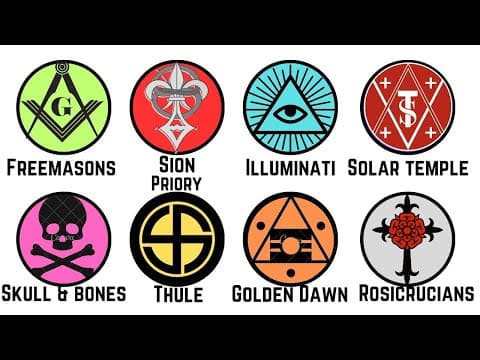
Founded in 1776 by Adam Weishaupt in Bavaria, the Illuminati aimed to promote Enlightenment ideals and challenge religious and political oppression. Although suppressed in 1785, the group has become central to numerous conspiracy theories, often portrayed as a shadowy organization manipulating global events.
Freemasonry, with roots dating back to the late 16th century, emphasizes moral integrity, personal development, and brotherhood. Known for its secrecy and elaborate rituals, Freemasonry has influenced many aspects of society and continues to thrive today.
Emerging in post-World War I Germany, the Thule Society blended esoteric beliefs with extreme nationalist ideologies. It played a significant role in the early development of Nazi ideology, promoting ideas of Aryan superiority.
The Rosicrucians are a mystical movement that emerged in the early 17th century, known for blending esoteric knowledge with spiritual enlightenment. They seek personal transformation through the study of alchemy, astrology, and cabala.
Founded in 1887, the Golden Dawn was influential in the development of Western occultism. It focused on the study and practice of the occult, blending various esoteric traditions and emphasizing personal transformation through ritual and meditation.
The Order of the Solar Temple was a secretive cult that gained notoriety in the 1990s for a series of mass suicides and murders. Founded in 1984, it combined elements of Christian mysticism and conspiracy theories, ultimately leading to tragic outcomes.
Founded in 1832 at Yale University, Skull and Bones is known for its exclusivity and secrecy. It has produced many influential members in politics and law, fueling conspiracy theories about its members' control over key institutions.
The Essenes were an ancient Jewish mystical sect known for their ascetic lifestyle and communal living. They sought to preserve their way of life and are often associated with the Dead Sea Scrolls, believed to have been written by them.
Modern groups like the Temple of Black Light and the Joy of Satan have emerged, blending various esoteric and occult traditions. These organizations often face controversy due to their radical beliefs and practices.
The exploration of secret societies reveals a rich tapestry of beliefs, practices, and historical significance. From the Knights Templar to modern organizations, these groups have shaped cultural narratives and continue to intrigue those fascinated by the hidden aspects of human society. Their legacies, whether through military prowess, philosophical teachings, or controversial practices, remind us of the complex interplay between secrecy, power, and belief throughout history.



















