
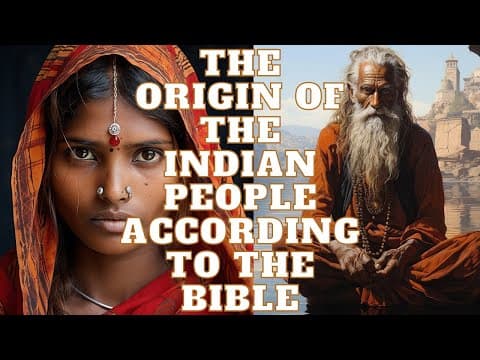
This blog post delves into the origins of Indians and Gypsies as described in the Bible, examining their ancestral roots, genetic influences, and historical migrations that shaped their identities.
Welcome to a fascinating exploration of the origins of two distinct yet interconnected groups: the Indians and the Gypsies. This post will investigate their roots according to biblical texts, genetics, and historical accounts, shedding light on their complex identities.
The Vedic texts, ancient sacred scriptures of India, mention conflicts with a group known as the Dacia. The Indus civilization, characterized by its inhabitants' darker skin tones, suggests that the native peoples of India are descendants of Noah's son Ham. This lineage is particularly evident in the southern regions of India, where the population predominantly exhibits darker skin tones.
Indians are primarily considered to be of Hamitic descent, which is supported by their natural skin color. However, there has been significant intermingling with a lighter-skinned ethnic group known as the Aryans. This group, likely of Japhethic origin, emerged around 3700 years ago and contributed to the ethnic diversity in India.
The interaction between the Hamitic and Japhethic peoples led to a notable ethnic division in India. The northern regions became home to lighter-skinned individuals with blue or green eyes, while the southern regions retained a population with darker skin tones. This blending of ethnicities is exemplified by the presence of individuals with diverse physical traits, such as a black woman with blue eyes, indicating the historical mixing of these groups.
By 500 BC, light-skinned Aryan invaders had established dominance in India, further contributing to the ethnic amalgamation. Additionally, the influence of Tagarma, considered the father of the Asians, played a role in shaping certain Indian groups. The presence of straight hair among some black-skinned Indians suggests a complex ancestry that includes both Hamitic and Japhethic elements.
The Gypsies, or Roma people, have a mysterious and nomadic history that has puzzled scholars for centuries. Their language, Romani, is unwritten, and many of their customs involve forgetting historical records, complicating the understanding of their origins.
Various theories have emerged regarding the Gypsies' origins, suggesting links to Egypt, Persia, Morocco, Romania, and the Ottoman Empire. However, systematic studies of the Romani language in the 18th century revealed that it belongs to the Aryan branch of Indo-European languages, indicating a primary origin in North India.
Genetic tests conducted in 2012 analyzed the DNA of 152 individuals from 13 different Gypsy groups, confirming that the Roma trace their ancestry back to Northern India, specifically the Punjab region. This aligns with linguistic findings, reinforcing the idea that the Gypsies are fundamentally an Indian people who migrated and mixed with other cultures over time.
The migration of the Roma from North India is believed to have been prompted by invasions, particularly by Sultan Mahmoud Ghazni. As they traveled across various regions, they interacted with other cultures, including Persians and Arabs, leading to a rich tapestry of influences in their customs and traditions.
Today, there are three major branches of Gypsies: the Ram, the Kalan, and the Sindhi. In the United States, various Roma communities preserve their unique traditions and languages, contributing to the cultural diversity of the nation. In Brazil, the Kalan were among the first to arrive, followed by other groups from Turkey, Greece, and Germany.
The Gypsies' biblical origins can be traced back to the descendants of Japheth, with their mixed heritage explaining the variety of skin tones within the community. This dual ancestry highlights the complex history of both Indians and Gypsies as they navigate their identities in contemporary society.
In summary, the origins of Indians and Gypsies are deeply intertwined with biblical narratives and historical migrations. Both groups exhibit a rich blend of ancestries that reflect their unique journeys through time. Understanding these origins not only enriches our knowledge of their histories but also fosters appreciation for their cultural identities.
Thank you for joining this exploration of the origins of Indians and Gypsies. If you have any connections to these groups, feel free to share your experiences and insights in the comments.



















