
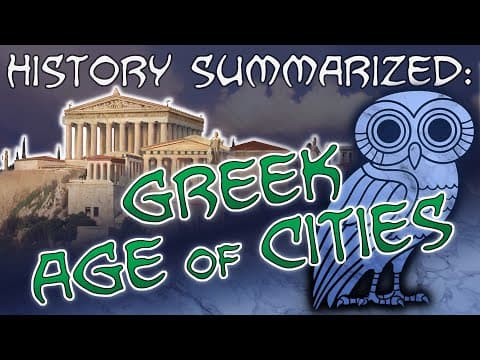
The Greek Age of Cities, or the Archaic Period, marked the emergence of independent city-states known as Poleis, which shaped Greek civilization through a unique blend of individuality and collective identity. This era saw the development of diverse political systems, the significance of warfare and sports, and the cultural unity among the Greeks despite their political fragmentation.
When the Greek world emerged from its four-century slumber known as the "Dark Ages," it did so under a new and transformative configuration. The remnants of the Bronze Age, characterized by grand palaces and powerful kings, had long been buried under the collapse of civilization. In their place arose the Polis, or city-state, marking the beginning of a new era in Greek history.
The mid-700s BC heralded the rise of numerous independent city-states across the Aegean Sea, each comprising an urban center and its surrounding countryside. These city-states, known as Poleis, were unique in their laws, government structures, and customs, yet they shared a common Greek identity. This period, referred to as the Archaic Period, is often seen as Greece's Age of Cities.
Plato famously described this arrangement as "frogs around a pond," with each Polis representing a distinct community bound by language, religion, and civic participation. The Greek civilization expanded from Gibraltar to the Black Sea, with Poleis established in regions such as Sicily, southern Italy, Anatolia, Cyprus, North Africa, and the Caucasus Mountains.
Each Polis was a product of its land and people, leading to a variety of governance systems. Most were oligarchies ruled by a small group of aristocrats, but notable exceptions existed. For instance, Sparta was governed by twin dynasties of kings supported by councils, while Athens pioneered a form of democracy known as Demokratīa in 508 BC.
Interestingly, the term "Tyranny" originally referred to leaders who seized power without election, often resulting in benevolent rule. The Cypselid dynasty of Corinth is a prime example, transforming the city into a significant economic hub.
One of the greatest threats to a city-state was Stātis, or internal factional discord. This could range from political disputes to civil wars, often leading to the rise of a tyrant who would restore order. Citizens frequently faced the challenge of maintaining their civic autonomy amidst these conflicts.
In a landscape where no single Polis dominated, inter-city competition was crucial. Disputes over land and resources often escalated into warfare. Contrary to earlier beliefs that Greek warfare was organized and sport-like, recent scholarship suggests it was more chaotic and brutal. The citizen-soldier model emerged, where Hoplites—armed citizens—fought for their city, earning civic rights through their military service.
Alongside warfare, sports played a vital role in Greek culture. Beginning in 776 BC, the Olympic Games held at Olympia became a significant event, attracting athletes from across the Greek world. These games celebrated individual excellence in various athletic disciplines and fostered a sense of pride among the competing city-states.
The Olympics were not just a sporting event; they were a religious festival dedicated to Zeus, protected by a sacred truce that allowed safe passage for athletes and spectators. This truce underscored the Greeks' prioritization of religious observance over political strife.
The Olympics were one of four Pan-Hellenic games, alongside the Nemean, Isthmian, and Pythian games. The Pythian games, held at Delphi, were particularly significant due to the Oracle's prophetic guidance, influencing decisions of great importance, including military strategies.
These Pan-Hellenic events provided a platform for collective Greek identity, allowing individual Poleis to showcase their cultural achievements while reinforcing a shared heritage.
Art and culture flourished during this period, with distinctive styles in pottery, sculpture, and architecture emerging. The Greeks sought to capture the beauty of nature while adhering to mathematical principles, laying the groundwork for philosophical thought that would later define Greek civilization.
The Greek Age of Cities was characterized by a complex interplay between individuality and collective identity. Each Polis served as a microcosm of Greek society, where citizens engaged in politics, warfare, and cultural pursuits. The term "Politics" itself derives from the Greek word Πολιτική, reflecting the significance of civic engagement in the affairs of the Polis.
In essence, the Greek experience was defined by the balance between the individual and the collective, shaping what it meant to be Greek in this vibrant and dynamic era. The legacy of the Polis continues to influence our understanding of governance, culture, and community today.



















