
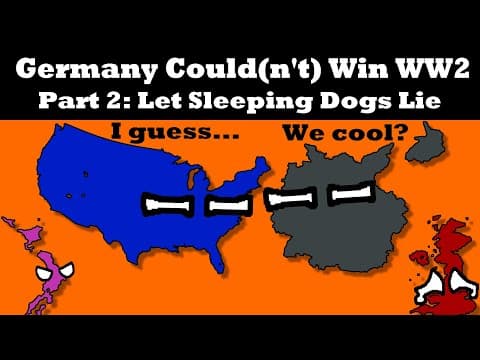
This blog post delves into various scenarios that could have allowed Germany to avoid defeat in World War II, focusing on the crucial role of the United States' involvement. It examines the implications of Germany not declaring war on the U.S., the impact of Japan's actions, and the potential outcomes of different leadership in America. Each scenario is analyzed for its realism and potential impact on the war's outcome, providing insights into the complex dynamics of this historical conflict.
This is the second episode in a larger series examining the possibilities of Germany winning World War II. In this post, we will explore various scenarios that could have allowed Germany to avoid defeat, focusing particularly on the crucial role of the United States' involvement in the war. We will analyze the implications of Germany's decisions, the actions of Japan, and the potential outcomes of different leadership in America.
For Germany to achieve a full victory in World War II, several factors must be accomplished:
The focus of this episode is on the last point. The entry of the United States into the war significantly tipped the scales against Germany. The U.S. had a far superior industrial capacity, better scientists, more resources, and a more effective military structure. The involvement of the U.S. in the war, especially in conjunction with Britain, almost guaranteed a German defeat.
One of the most discussed scenarios is whether Germany could have avoided declaring war on the United States after the attack on Pearl Harbor. After Japan's strike, the U.S. was primarily focused on the Pacific War, and there was hesitation about entering a conflict against Germany. However, Germany declared war on the U.S. just days after Pearl Harbor, which solidified American involvement in the European theater.
From the German viewpoint, the declaration of war was seen as a formality. They believed that the U.S. was already supporting Britain and engaging German submarines in the Atlantic. Moreover, Germany feared that if they did not declare war, the U.S. might focus all its efforts on defeating Japan, leaving them free to enter the European conflict later with full strength.
The idea that Germany could have refrained from declaring war is rated around a six in terms of realism. While it is plausible, the U.S. was already engaged in the war indirectly. Even if Germany had not declared war, the likelihood of American entry into the conflict remained high due to ongoing German attacks in the Atlantic.
Another significant scenario to consider is what would have happened if Japan had not attacked Pearl Harbor at all. This would have kept the American public from being shocked into supporting a war against Germany, potentially delaying U.S. involvement.
Japan's decision to attack was driven by desperation. They were facing economic sanctions from the U.S. due to their expansionist policies in China and Indochina. The attack on Pearl Harbor was seen as a necessary move to secure resources and assert dominance in the Pacific.
The scenario of no Pearl Harbor is rated around a seven or eight in terms of impact. However, it is deemed unrealistic because Japan's militaristic leadership was unlikely to avoid such a confrontation. Even without Pearl Harbor, the U.S. might still have found reasons to intervene due to ongoing tensions.
What if Japan had chosen to declare war only on the Dutch and British, avoiding direct confrontation with the U.S.? This strategy could have delayed American involvement, but it was fraught with risks.
Japan's military leadership was unlikely to take such a gamble without incapacitating the American Pacific Fleet first. The potential for American intervention remained high, and the risks of provoking the U.S. were significant.
This scenario is rated around a four in terms of realism. While it could have worked in theory, the Japanese leadership's mindset and the geopolitical realities made it a risky proposition.
The leadership in the U.S. during this period was crucial. Franklin D. Roosevelt's interventionist policies significantly influenced American support for the Allies. What if a more isolationist president had been in power?
If an isolationist president had been elected, American support for Britain would have been severely hampered. The lack of military goods and financial support would have weakened Britain's war effort, potentially allowing Germany to gain the upper hand.
This scenario is rated around a three in terms of realism, but the impact could be as high as nine or ten. A significant reduction in American support could have led to a German victory, especially if they played their cards right against the Soviets.
Another hypothetical scenario involves the assassination of key Allied leaders, such as Roosevelt, Churchill, and Stalin. While this idea has been discussed, its impact would likely be minimal.
The realism of successfully assassinating these leaders is rated low, around a three. The security surrounding such high-profile figures would make it extremely difficult.
Even if successful, the impact on the war would likely be limited. By 1943, the Allies had already gained significant momentum, and the loss of leadership would not change the overall trajectory of the war.
In conclusion, the scenarios explored in this post illustrate the complex dynamics of World War II and the various factors that could have influenced Germany's chances of victory. While some scenarios present plausible alternatives, the overarching reality is that the entry of the United States into the war was a decisive factor in the eventual defeat of Germany. The interplay of military strategy, leadership decisions, and geopolitical realities created a multifaceted conflict that shaped the course of history.
As we continue this series, the next episode will delve into Operation Barbarossa and potential changes to the Eastern Front, which is key to any German victory. Thank you for reading, and stay tuned for more insights into this fascinating historical topic.



















